This Psychology of Desire Case File is the first in an ongoing series exploring the female orgasm, informed by original data from The Her Climax Code and long-form erotic psychology interviews from The Erotic Realm Podcast.
Rather than asking “What is a female orgasm?”, this series asks a more revealing question:
How is the female orgasm experienced?
What Is The Her Climax Code?
The Her Climax Code is an independent, research-informed survey project designed to map how women actually experience orgasm — not how textbooks, porn, or cultural myths say they should.
Rather than reducing orgasm to a single physiological endpoint, the project approaches orgasm as a lived, subjective experience.
The survey captures data on:
How individuals define orgasm in their own words.
Orgasmic patterns.
Triggers for orgasm.
Contextual factors such as safety, attention, ritual, relationship dynamics, and mood.
Variations across gender identity, sexual orientation, and age.
The dataset combines quantitative measures with rich qualitative descriptions, allowing both statistical insight and phenomenological depth.
So far 240 people— including 167 women have participated (all genders were invited to participate).
What emerged was not a single definition of orgasm but a wide spectrum of orgasmic experiences, many of which are poorly represented in mainstream sex education and clinical models.
There is a lot of fascinating data to explore, and it will take more than one Case File to break it all down, but for now let’s focus on 3 Myths about the Female Orgasm.
Hyper-climaxers don’t exist.
Women need 20-30 minutes to orgasm.
Orgasm is a purely physical event.
Three Persistent Myths About Female Orgasm
Myth 1: “Hyper-climaxers don’t exist.”
In a recent episode of The Erotic Realm Podcast, I explored the erotic psychology of a woman who can orgasm hundreds of times in a single session.
Yes, you read that right.
For many listeners, this immediately triggers disbelief.
“Surely that must be exaggeration.” ”Surely that can’t be real.”
And yet — when we look at experiential data alongside contemporary sexological research, the picture becomes far more nuanced.
After discussing the guests hyper-climaxing on the podcast, and us both being stumped on how to exactly define hyper climaxing, I did some research to see what the official definition is.
You may be as surprised as me to know that there is currently no official or clinical definition of a hyper-climaxer in medical or psychological literature.
It is not a diagnostic category, nor a term used in formal Sexological research.
Luckily, I asked how women who have experienced multiple orgasms would describe them in the Her Climax Survey.
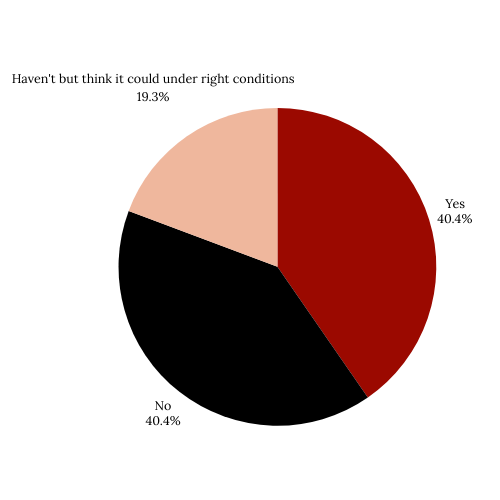
I also asked: Have you ever experienced hyper-orgasmic states (e.g., 10+ orgasms in one session/30mins)?
In a sample of 166 respondents, experiences of hyper-orgasmic states were evenly split: 40.4% reported having experienced 10+ orgasms in a single session, while an equal 40.4% reported never having experienced this.
A further 19.3% had not experienced hyper-orgasmic states but believed they could under the right conditions.
Taken together, nearly 60% of respondents either access or perceive access to hyper-orgasmic response, indicating that hyper-orgasm is not a rare or fringe phenomenon but a condition-dependent mode of erotic functioning shaped by context, attention, and psychological or relational factors rather than simple physiological ability alone.
Women who reported multiple or extended orgasmic experiences described patterns that were strikingly consistent:
multiple orgasms in a single session, often with minimal or no refractory period.
extended orgasmic states lasting minutes rather than seconds.
heightened sensitivity to stimulation, including psychological, emotional, or imaginative triggers.
experiences resembling erotic trance or altered states of consciousness.
reports of non-genital orgasms involving the head, chest, breath, spine, or whole body.
When participants were asked, in free-form language, how they define multiple orgasms and how they know when one orgasm ends and another begins, they did not converge on a single definition.
Instead, they revealed something more important.
Women rely on different internal boundary detection systems to recognise orgasmic transitions.
Attentional boundaries — awareness “comes back” and then drops again.
Energetic boundaries — a wave subsides or continues.
Emotional boundaries — surrender resets or deepens.
Relational boundaries — stimulation changes or pauses.
Narrative boundaries — “that felt like one” versus “that felt like many”.
These boundary systems combine in different ways, producing different orgasmic patterns.
Some women experience orgasms as discrete, countable events. Others experience serial orgasms within a single erotic session. Others experience orgasm as a continuous wave with multiple peaks. Others describe orgasms that stack or intensify, where each climax deepens the next.
For women whose orgasms are experienced as extended states or continuous waves, counting orgasms becomes conceptually meaningless — not because the experience is exaggerated, but because the model used to interpret it is wrong.
This is the missing link in the hyper-climaxer debate.
Many reports of “dozens” or “hundreds” of orgasms are not claims of hundreds of discrete physiological events. They are descriptions of prolonged orgasmic absorption with many internal peaks, experienced without full collapse of arousal.
In other words:
Hyper-climaxing is not incompatible with biology. It is incompatible with simplistic orgasm models.
Related Concepts in Research
While hyper-climaxer is not a formal research term, adjacent phenomena are well documented.
Clinical reviews emphasise extraordinary inter-individual variability in orgasm frequency, duration, and recovery time, arguing against a single normative model of climax (Jannini et al., 2018; Jannini et al., 2024).
Recent work frames orgasm as a multidimensional phenomenon, involving cognitive, emotional, attentional, relational, and neurophysiological processes — not merely genital reflexes (Jannini et al., 2024).
This is distinct from Persistent Genital Arousal Disorder (PGAD), which is typically unwanted and distressing. Hyper-climaxing, as described in the Her Climax Code data, is not pathological, but a positively experienced phenomenon and very much welcomed by those who experience them.
Working Definition: Hyper-Climaxer
For the purposes of this Case File:
A hyper-climaxer is an individual who experiences an unusually high frequency, intensity, or duration of orgasms — often within a single sexual encounter — characterised by rapid orgasmic build-up, minimal refractory period, and the capacity for extended or multi-peak orgasmic states.
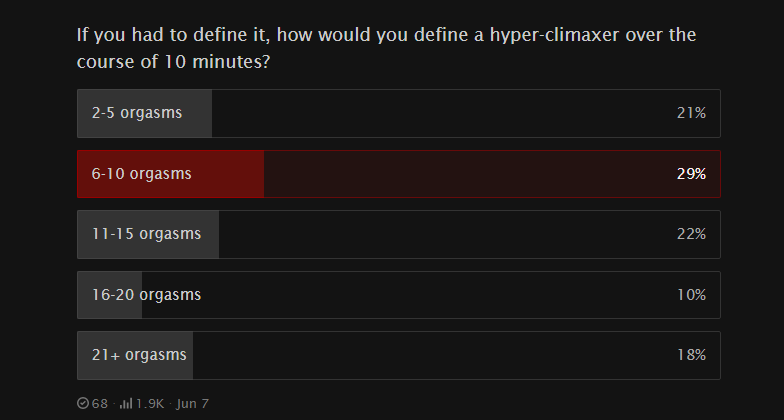
Question is: what is an unusually high frequency? This survey from Fetish website Fetlife suggests >5 orgasms in 10 minutes is considered hyper sexual by most.
Conclusively, there is no particular number attached to hyper climaxing, but rather it appears to exist on a spectrum of orgasmic potential.
Myth 2: “Women need 20–30 minutes to orgasm.”
This idea is everywhere.
It appears in sex education, relationship advice, therapy models, magazine articles, and even well-meaning feminist discourse. It is often framed as a corrective to male-centric sexual scripts:
Men are quick. Women are slow. Give her 20–30 minutes.
But when examined closely, this claim turns out to be a cultural heuristic, not a biological law.
Where the idea comes from
The notion that women “take longer” emerged from early sexological research and was later reinforced by therapeutic models emphasising responsive desire.
Over time, this nuance was flattened into a soundbite: women need 20–30 minutes to get turned on.
Importantly, this figure was never intended to be a universal metric for orgasm.
It was a rough proxy for:
sufficient genital blood flow
lubrication for comfort
psychological settling into erotic context
What the data actually shows
Large-scale studies measuring orgasmic latency consistently report much shorter average times.
Reviews and observational studies place average orgasmic latency during partnered sex between 10–15 minutes, with masturbation typically producing orgasm more quickly (Jannini et al., 2018).
More recent analyses suggest typical latency often clusters around 10–12 minutes, with substantial individual variation (Jannini et al., 2024).
Educational summaries from the International Society for Sexual Medicine echo this finding: orgasm does tend to take longer during partnered sex than masturbation, but there is no evidence for a universal 20–30 minute requirement.
When latencies extend beyond this range, they are associated with:
orgasmic difficulty
attentional interference
anxiety or lack of safety
relational mismatch
inadequate or misaligned stimulation
Not with female biology itself.
Thermal imaging and physiological studies show that genital arousal can occur in women within minutes, often on a similar timeline to men (Kukkonen et al., 2007).
What varies more widely is attentional and emotional readiness — the ability to remain present, focused, and unguarded long enough for orgasmic processes to unfold.
Time itself is not the mechanism.
Attention is.
Why the myth persists
The “20–30 minute rule” persists because it performs a social function: it pushes against rushed, penetration-focused sex.
But when mistaken for biology, it creates new problems:
women who orgasm quickly may feel abnormal
women who need context may feel “slow” or broken
partners may focus on the clock instead of the conditions
A better framing is this:
Women do not need a certain amount of time. They need the right conditions.
Attention as an Erotic Resource: What the Her Climax Code Data Reveals
When participants in the Her Climax Code survey were asked:
“How much do you think your (or the women you’re with) ability to focus affects your/their ability to orgasm?”
The results were strikingly consistent.
When 167 women’s responses were grouped into meaningful categories, the distribution revealed:
High impact of attention (“Extremely” + “Quite a bit”) → ~70% of respondents
Moderate impact of attention (“Moderately”) → ~20–22% of respondents
Low or no impact of attention (“A little” + “Not at all”) → ~8–10% of respondents
In other words:
Nearly 9 out of 10 respondents report that attention affects orgasm at least moderately — and roughly 7 out of 10 say it affects it strongly.
This positions attention not as a secondary influence, but as a core erotic resource.
If orgasm were primarily mechanical or time-dependent, focus would play a minor role. Instead, the data suggests orgasm depends on the ability to sustain attention on erotic sensation, resist attentional fragmentation, and remain within an erotic frame long enough for climax to unfold.
When attention collapses — through distraction, self-monitoring, performance awareness, or intrusive thought — orgasm falters, regardless of how much time or stimulation is present.
Culturally, we are far more comfortable talking about time than attention. Time is external, measurable, and socially neutral. Attention is internal, vulnerable, and psychologically charged. So when orgasm does not occur, people say:
“I need longer.”
“It takes me a while.”
“I need more build-up.”
But what I suggest they are often describing is the difficulty of holding erotic attention.
This attentional framing also clarifies a consistent finding in sex research: orgasm tends to occur more quickly and reliably during masturbation than during partnered sex. The difference is not simply technique. During solo stimulation, attention is unified and uninterrupted. During partnered sex, attention is divided between sensation, partner feedback, relational meaning, and self-awareness.
Time can compensate for this division — but it does not cause orgasm.
Attention does.
The attentional dependence seen in this dataset also helps explain why safety, trust, and emotional containment repeatedly appear in orgasm narratives. When safety is present, vigilance drops and attention settles into the body. When safety is absent, attention remains partially external, and orgasm may require more time — or not occur at all.
What is often described as “needing more time” is more accurately described as needing sufficient attentional bandwidth.
The importance of attention was also highlighted in the recent Erotic Realm podcast with the hyper-climaxer that was linked earlier— as they had mindfulness training that no doubt had an impact on their ability to maintain orgasmic states.
Makes you think about attention in a sexier way, perhaps?
Myth 3: “Orgasm is a purely physical event.”
If orgasm were purely physical, women would describe it primarily in mechanical terms.
They don’t.
When women in the Her Climax Code survey were asked to define their orgasm in their own words, many did mention physiological markers — contractions, pulsing, spasms, release. But just as often, and sometimes more prominently, they described something else entirely.
Orgasm, in lived experience, is repeatedly framed as a shift in state.
It is described as a build-up and release, yes — but also as:
a collapse of attention into sensation
a loss of self-consciousness
a flooding of emotion or calm
a wave that moves through the body
a moment where the mind goes quiet
a sense of expansion, surrender, or presence
Some women describe orgasm beginning in the genitals and then spreading outward.
Others describe it as full-body from the start.
Some emphasise muscular contractions; others barely mention them at all.
Many reach for metaphor — electricity, waves, fireworks, earthquakes.
Several respondents explicitly noted how hard orgasm is to define:
“Oh, this is hard.”
“I don’t know how to describe it.”
“Too complicated to answer.”
This difficulty is not a flaw in the data.
It is the data.
The challenge of defining orgasm points to a deeper issue in how orgasm has been studied.
Much of the existing research prioritises what can be easily measured — contractions, fluids, timing — while overlooking phenomenology: the subjective, first-person experience of orgasm as it is actually lived.
What emerges from this dataset is not a single definition, but a range of recurring experiential patterns.
Some definitions emphasise release.
Others emphasise intensity, presence, energy, emotion, or aftermath.
Some describe explosive peaks; others describe subtle waves.
Some describe a moment; others describe a state that unfolds over time.
What unites them is that orgasm is almost never described as only a bodily reflex.
It is an event that involves attention, emotion, meaning, and nervous-system state, alongside physical sensation.
For many women, orgasm includes a profound shift in awareness — a moment where thinking drops away and experience takes over.
This directly challenges the idea that orgasm can be fully understood through anatomy alone.
The female orgasm is often physical — but it is rarely only physical.
It is embodied, psychological, attentional, and relational. It is felt, interpreted, remembered, and integrated.
What Comes Next
This Case File is only the beginning.
Future analyses will explore:
differences in how women and men describe female orgasm
trans and gender-diverse orgasmic experiences
patterns across sexual orientations
age-related shifts in orgasm narratives
rituals and conditions that reliably support orgasm
Announcing
The Psychology of Desire Masterclass Series — 2026
Where science, symbolism, and the erotic mind converge.
In 2026, I’m launching a new live masterclass series exploring the psychology and phenomenology of human desire.
The first masterclass will focus on:
The Phenomenology of Female Orgasm: Inside the Her Climax Code Data
In the upcoming Her Climax Code masterclass, these recurring orgasmic patterns will be explored in depth — not as rigid categories, but as distinct phenomenological shapes that help make sense of why orgasm feels so different across people, contexts, and moments.
Drawing on over 240 survey responses, we’ll explore:
how women vs men define the female orgasm in their own words
the dominant orgasmic boundary systems
the role of attention, safety, and surrender in orgasmic states
6 archetypes of female orgasm
how to explore the different archetypes of orgasm
and much more!
If you’ve ever thought there was more to understand about the female orgasm, or ‘my orgasm doesn’t fit the script,’ this masterclass is for you.
Join the early interest list to receive dates, tickets, and early-bird bonuses here.
Psychology of Desire is a reader-supported publication. To receive new posts and support my work, consider becoming a free or paid subscriber.
2026 is the year we map the erotic mind.
And I’m so excited to keep exploring with you.
Emma
Founder of Psychology of Desire | Host of The Erotic Realm
Want to dive deeper into your desires with me personally? I offer 1:1 Coaching via application. Find out more here.
The Psychology of Desire partners with aligned brands in the realms of psychology, sexuality, and symbolic transformation. Interested in sponsoring?Start here.




Pitty this didn’t come an half century earlier.
This is excellent. Thank you.