


What do I mean by the Individuation of Desire?
The easiest way to begin to explain the Individuation of Desire is to start with what it is not.
It is not Disconnection
It is not Impotent
It is not material
It is not ignorant
It is not uninspired
I still remember the first time I truly experienced what I would now describe as someone having embodied the Individuation of Desire.
It was at the beginning of my journey into Eastern Sexology when I went to my first presentation about the topic of tantra.
This was a big move for me as I was such a devout lover of quantitative science at the time.
I didn’t know much about the topic at all.
And to be honest, I can’t tell you a whole lot about what was specifically said that night.
But what I do remember is where I was sitting and a feeling.
This feeling came over me the moment one of the presenters walked into the room.
I’d met people with presence before, but she was different.
As soon as she walked in the room I could feel a magnetism to her energy.
I somehow KNEW that she was connected deeply to her sexuality, just by her presence.
It was something:
Imperceptible,
Numinous,
Transcendent.
I could feel something deep within me yearning for what she had.
Unfortunately at the time I didn’t know how to access it for myself.
But the experience was the spark of a long journey into sexuality and authenticity.
Sexuality has been the focus of my growth and what I offer for 3 main reasons:
1. There is an inherent truth to our sexuality.
The scientific part of my brain is appeased by the truth of our sexuality.
No matter how hard you try, it is incredibly difficult- some may say completely impossible to change who and what contexts you are attracted to.
I'd argue the theme of our desires are generally unchanging and pervasive through most of our lives.
There is recognition of inherent desire templates by many notable sexologists (more on this another time).
This is not randomness. It is self revelation.
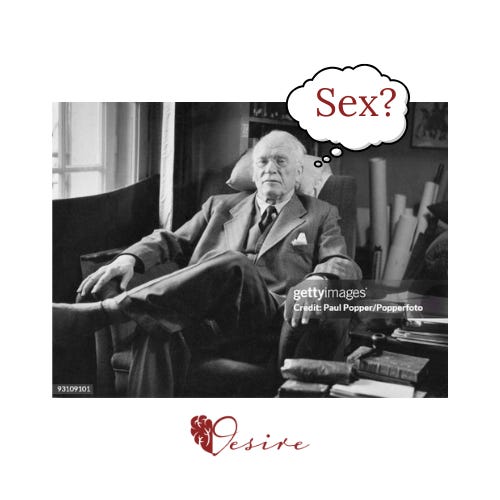
2. Sexuality is a powerful path to individuation.
Carl Jung defined individuation as the process of becoming one’s true self—the integration of the unconscious and conscious aspects of the psyche.
Few aspects of the human experience hold as much unconscious material as sexuality. Our desires, fantasies, and attractions are rich with meaning, often pointing toward the hidden parts of ourselves.
“If you possessed your desire, and your desire did not possess you, you would lay a hand on your soul, since your desire is the image and expression of your soul”
C. G Jung.
Understanding our sexuality isn’t just about pleasure, it’s about wholeness.
3. Connecting to our sexuality is deeply empowering.
Looking back, I now realize that what I felt in that tantric woman wasn’t just sexuality.
It was empowerment.
She had accessed something within herself, a deep alignment between her erotic energy and her sense of self.
And that radiated outward.
As Audre Lorde writes in Uses of the Erotic: The Erotic as Power:
The erotic is a source of power and information. Recognize, embrace and utilise your erotic energy in all facets of your life, be it in work, creativity or relationships- when connected you can achieve a sense of fulfilment and realise your potential.
When we recognise, embrace, and channel our erotic energy, we gain access to an immense source of creativity, confidence, and fulfillment.
This energy transcends sexuality and touches every aspect of our lives.
I have experienced this firsthand.
My own sexual exploration allowed me to see where I needed to grow, what my strengths were, and how to move through the world with confidence.
Sexual self awareness is an inner experience, one that no one can interfere with.
It is deeply liberating.
And to be clear: I’m not talking about acting on every desire.
I’m talking about the power of knowing what those desires are.
Viseros: The Power of Desire
This led me to search for a term that encapsulated what I had witnessed time and time again:
The transformation that occurs when someone truly integrates their sexuality.
I explored different concepts: sexual integration? Too clinical. Sexual empowerment? Too narrow.
I needed something that conveyed four key ideas:
Sexual integration
Empowerment
The connection between sexuality and inner power
The ancient nature of this connection
And so, Viseros was born.
The name itself carries meaning:
Vis (Latin) – strength, power.
Eros (Greek) – love, desire.
An age old phenomenon with a brand new name.
Both are ancient terms signalling that this isn’t a new phenomenon but rather something that has existed in our psyche for arguably as long as we’ve had one.
Together, Viseros signifies the power of our desires- not just sexually, but holistically.
Viseros is what I saw in that tantric woman.
Viseros is what I’ve experienced in my own life.
And Viseros is what I witness in others who embark on this journey.
Imagine a World Where Everyone Had Access to Their Viseros
A world where people moved through life with an innate sense of self.
Where they not only knew their deepest desires, but had the courage and clarity to integrate them.
Their erotic energy integrated in a healthy way, impacting them not only in their bedrooms, but also their creativity, relationships, and ambitions.
From the bedroom to the boardroom.
This is the mission behind everything I create.
I’m sure you agree, the world would look and feel a little different, right?
So, what is Viseros to you?
Some questions for you to ponder:
What do you know about your eroticism and your desire template?
When do you feel the most empowered?
Where does your sexuality and empowerment collide?
Your sexual desires reveal more about your unconscious than you think. Next week, we explore how attraction and fantasy are shaped by archetypes.
Stay tuned for next weeks topic:
The Jung of Sex | The Erotic Mirror
And if you missed it, here is last week’s topic- the first in the Jung of Sex series:
The Jung of Sex | The Alchemy of Libido
Thanks for reading and commenting!
Emma
p.s want to explore my other writing?
Why Your Desires Are More Normal Than You Think.
What If Everything You Know About Men and Women Is Wrong?
The Jungian angle is especially compelling. If individuation is about integrating the unconscious and conscious, then sexuality is one of the most potent avenues for self-discovery. Society often teaches us to repress or externalize desire, but this post makes a compelling case for embracing it—not to act on every impulse, but to understand what those impulses reveal.
I’m curious—how do you see this approach helping people who feel disconnected from their sexuality? Would love to hear thoughts on how someone can begin integrating their erotic energy in a world that often shames it.
Thanks Emma. This is something I had long intuited. But you give it words!