


If you want to deep dive into the mind of a Cuckold I recommend listening to this episode of my podcast The Erotic Realm: #44 The Psychology of Cuckolding: Desire, Power & the Erotic Mind of CuckofanAngel. You could even listen while you read!
One of the most fascinating aspects of eroticism, for me, is that we can eroticise almost anything.
In fact, I challenge you to name something that no one, anywhere, has ever eroticised (and please tell me when you find it)!
Desire is an endless shapeshifter; with an unending appetite.
It feeds on…anything.
This Case File is about cuckolding and, some would argue, about jealousy.
Yes, we humans have managed to eroticise one of the most contradictory emotions to desire itself: jealousy.
We are often paradoxical creatures, and that sentiment is definitely true here.
But that’s not the whole story.
Cuckolding is far more complex and nuanced than the stereotypes suggest.
It is not simply humiliation or submission, nor merely voyeurism or betrayal.
I see cuckolding as an intricate psychological ritual—an alchemical process in which the psyche attempts to reconcile love, fear, and power through erotic theatre (and it even has ties to the greatest playwright himself William Shakespeare)!
In this Case File, I’ll explore how jealousy transforms from poison to pleasure, and how the human mind—ever inventive in its pursuit of meaning—can turn an event that may appear threatening into a catalyst for desire.
But we will go even deeper than this, demonstrating how although humiliation is in it’s roots, there are types of cuckolding differentiated by their psychological elements. And some that wouldn’t even fit into the original definition.
In fact there may even be a need for a new definition of the word itself.
Intriguing right?
Let’s begin.
The History of Cucks
Many people don’t realise that Cuckolding is named after a bird — the Cuckoo.

The cuckoo bird is infamous for its brood parasitism — laying its eggs in the nests of other birds. When the eggs hatch, the unsuspecting “host parents” raise offspring that are not their own.
Leaving us with a situation like the one below:
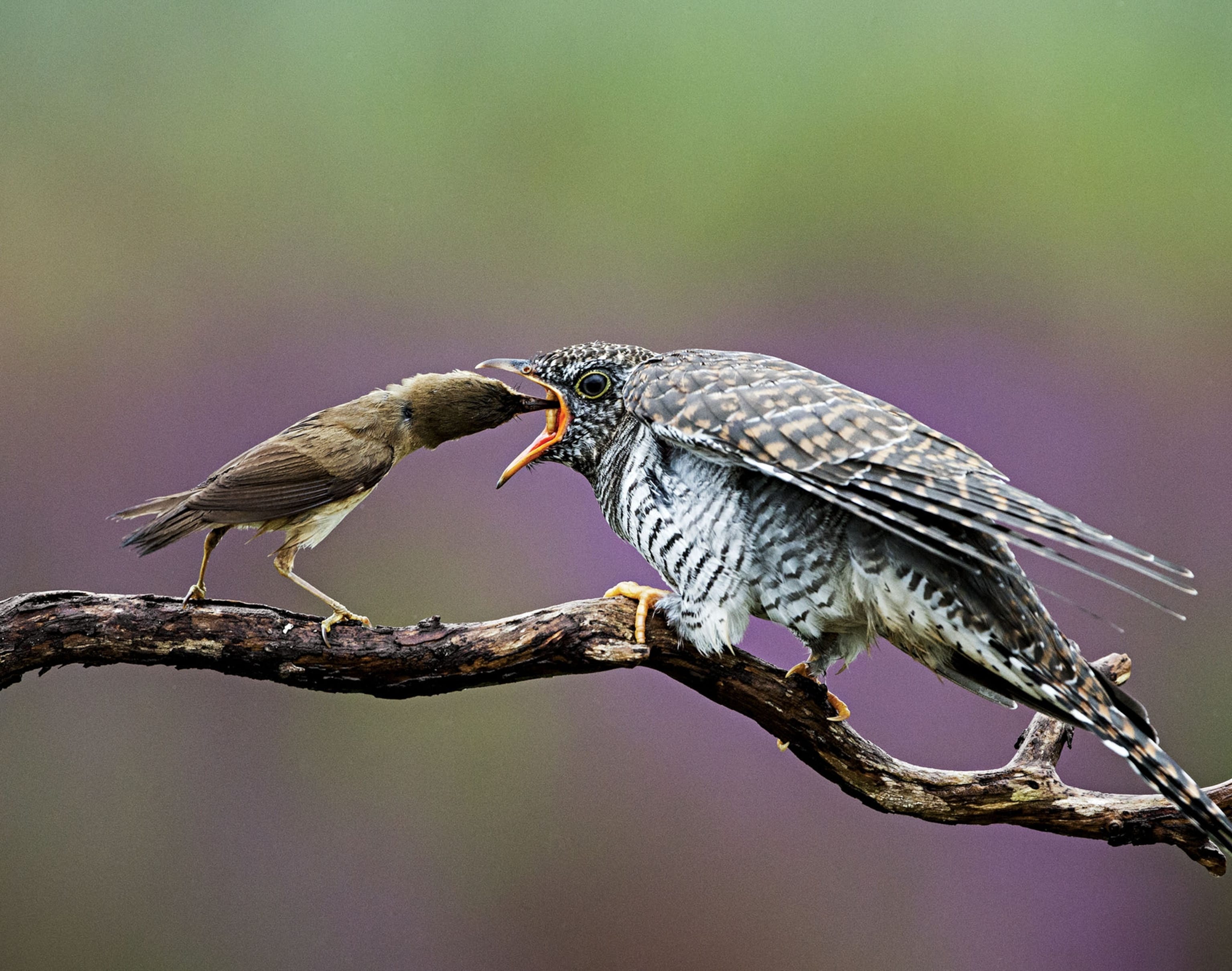
The current definition of cuckold is slightly different to what the cuckoo bird gets up to however.
To be a cuckold true to the origins of the word, a man would have to unknowingly bring up another man’s child.
And although that situation definitely happens, when most people use the word cuckold these days— it usually refers to a more erotic definition.
According to the Oxford dictionary a cuckold or cuckolding involves:
(of a man) make (another man) a cuckold by having a sexual relationship with his wife.
“in the novel Humberto cuckolds his employer”
(of a man’s wife) make (her husband) a cuckold by being sexually unfaithful.
“he was repeatedly cuckolded by his wife Aphrodite”
The first documented use of the word cuckold is attributed to the English poet and writer Chaucer in the late 14th century who used “cokewold” (the medieval version of cuckold) in books such as “The Miller’s Tale” where the term is used to describe the carpenter’s fear of being a cokewold and his attempts to control his young wife.
Shakespeare was the writer who made the term cuckolding popular in the 16th century, by using it in many of his tales including Othello, The Merry Wives of Windsor, King Lear, and Much Ado About Nothing — often for comedic or tragic effect.
Shakespeare often symbolised a cuck in his plays with horns adorned on the man’s head.
The Symbolism of Horns
The horns of the cuckold trace back to far older myths. In ancient Mediterranean fertility cults, horns symbolised virility and power — the force of the bull, the vitality of nature.
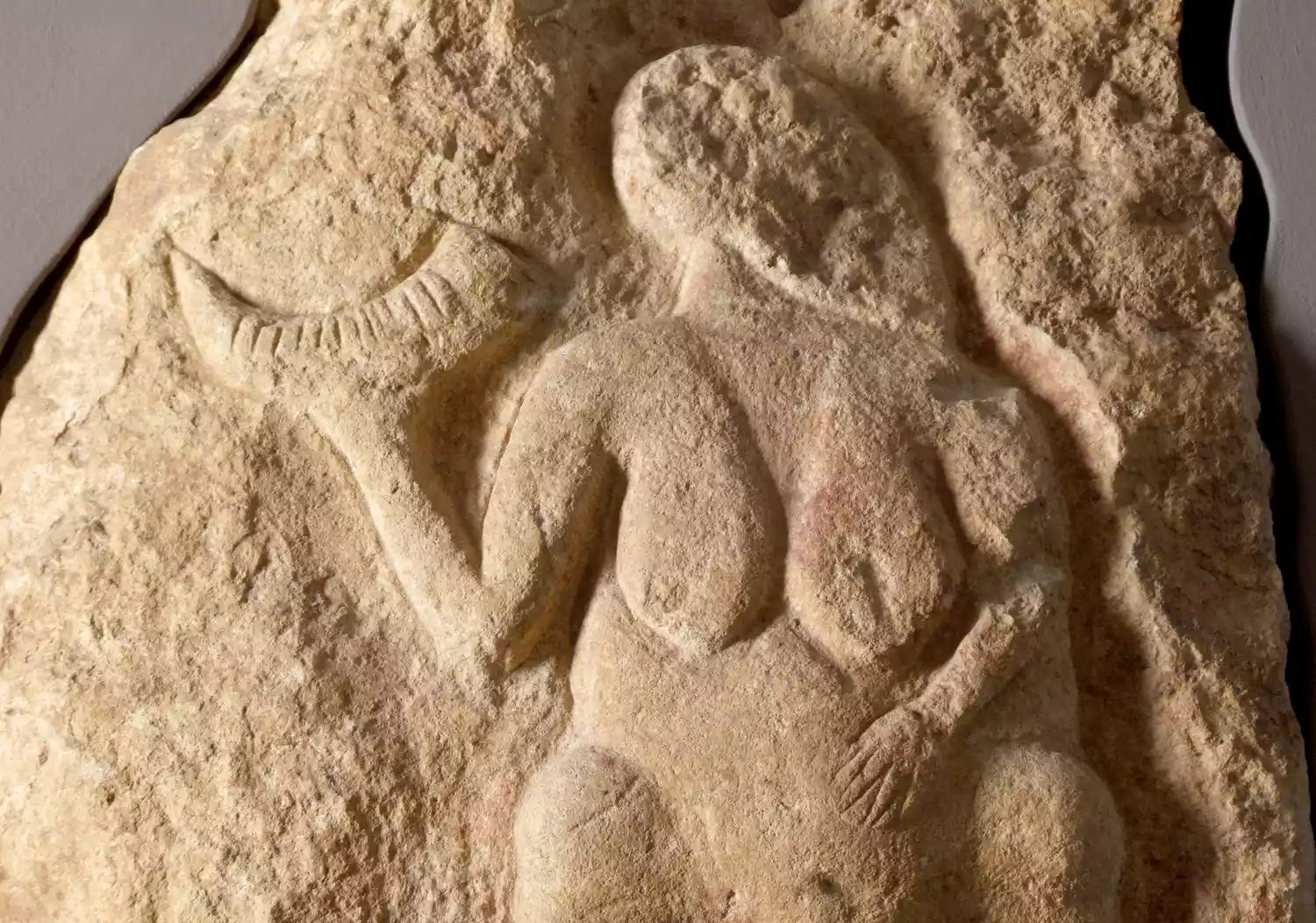
But when placed upon a deceived husband, that same symbol inverted. What once represented strength became a mark of humiliation. During medieval festivals, men accused of being cuckolds were forced to wear literal horned headpieces, transforming private betrayal into public spectacle. It was ritualised humiliation — an act designed to remind society that masculine control could be broken by feminine choice.
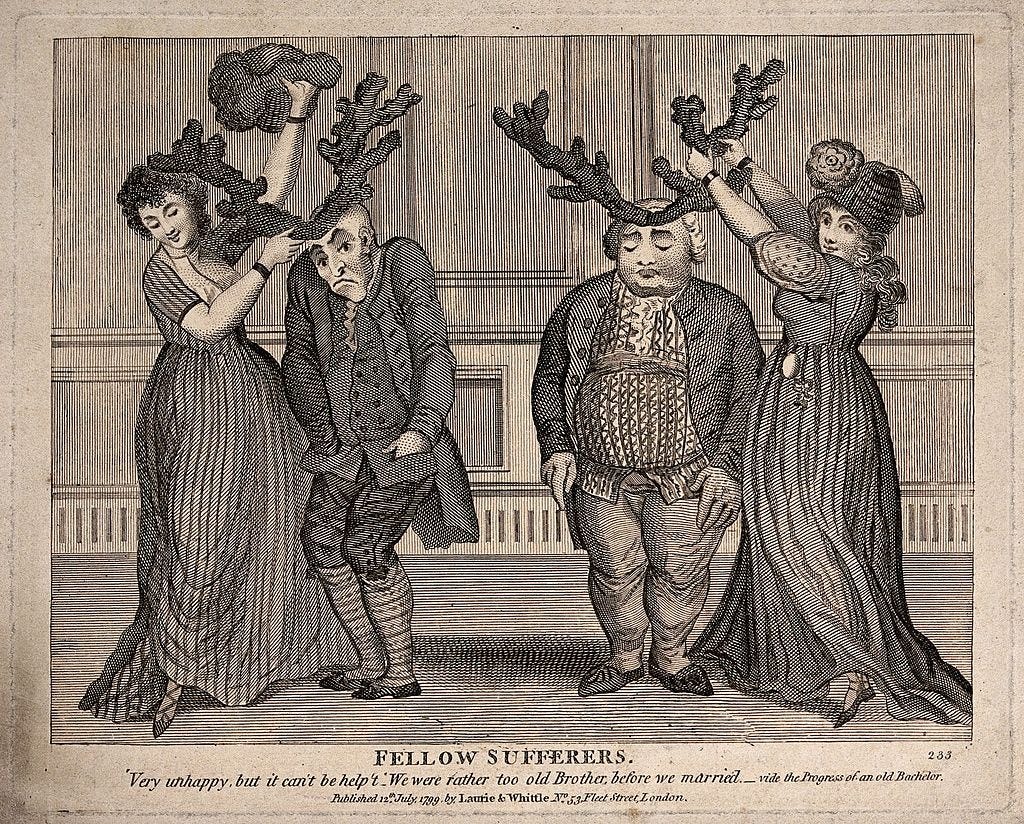

Women may not have had power in many aspects of daily life back then, but they held a very important power over men: their lineage.
The horns became a mythic shorthand for the paradox of desire itself: virility and vulnerability intertwined.….brings a whole new meaning to “feeling horny” huh?!
Although the term cuckolding became popular in Shakespeare’s writing in the 1600’s, it appears our interest in the term began to dwindle over time.
However cuckolding has made a comeback in the last 50 years, demonstrated by use of the term growing steadily since the 1940s.

In fact some sources suggest that 6 out of 10 men and 3 out of 10 women have fantasised by it. And by 2014 Searches for “Cuckold” on porn websites had increased by 57% in the prior 3 years.
SO what is it about cuckolding that fascinates so many people? Why would someone willingly be cucked by their partner?
According the Bedbible: There are many reasons why people start as cuckolds.
Psychologists suggest that it is an evolutionary thing where especially women look for better genes.
A sexual perspective where the couple together decides to try something new: because they think they need to spice their sex life up.
We are all living in a time where it’s more modern to be sexually free; meaning exploring your sexuality and trying all kinds of different sex things.
BUT
not every cuckold couple is seeking better genes for their man.
There’s plenty of ways to try something new without exploring cuckolding (threesomes for example where everyone is included!).
There are many ways to explore freedom in sexuality without cuckolding.
And therefore I have a different viewpoint of the why behind cuckolding.
The Psychology of Cuckolding
A reclamation: from Insult to Fetish
As we discussed, by the eighteenth and nineteenth centuries, cuckold had calcified into an insult — shorthand for emasculation, foolishness, and loss of honour.
But, like all language it didn’t stay still.
By the late twentieth century, the term began to mutate. In the same way that feminists reclaimed slut as a word of sexual autonomy rather than moral failure, the BDSM and fetish communities began reclaiming cuckold as a word of agency rather than degradation (although yes many enjoyed the degradation aspect too!).
Within these subcultures, humiliation became theatre, and theatre became transformation. Shame was not erased — it was ritualised, made conscious, made erotic.
The cuckold was no longer the fool of the village square but the devotee of his own undoing, finding pleasure in the very loss that once defined his disgrace.
By the 2000s, cuckold had become both a pornographic genre and a relational identity within consensual non-monogamy.
What was once an emblem of emasculation had become a stage for reclamation — a mirror image of the feminist slutwalk.

Both movements reveal the same psychological truth: when you take ownership of what could once be used to shame you, and ritualise the erotic- any emotion or stigma can be transformed into sovereignty, and the act of naming becomes the act of liberation.
And so the horns of the cuckold appear to have come full circle- from a symbol of virility and fertility to humiliation and shame and back to one tied with a sense of pride in identity.
This is what I love about eroticism.
The term cuckolding seems to simple at first, and yet once we start to pick it apart we go on a journey into etymology, history, literature, shame, ritual, ancient practices and empowerment.
No wonder cuckolding has so much interest— the term itself has been through its own heroic journey of loss and reclamation. Couple that with such strong feelings of shame, public humiliation and reclamation and it’s no wonder we are so fascinated with the phenomenon.
Although true that many cucks continue to fetishise the humiliation within their rituals of cuckolding, there are cucks who don’t find the practice humiliating at all.
In fact, for them it is an act of devotion to their partner (if you’re not already I suggest listening to the The Erotic Realm episode linked at the top of this post for a deep dive into a devotional cucks psychology- the romantic tone may surprise you!).
Types of Cucks
The Two Faces of Erotic Jealousy
Two ways the psyche turns jealousy into art.

When we listen carefully to the stories people tell about cuckolding , two distinct psychological movements emerge — two ways the human mind metabolises jealousy into meaning.
The first turns pain into power through the alchemy of humiliation.
The second transforms fear into reverence through the alchemy of devotion.
1. The Path of Humiliation: The Dethroned King
Where the devotional path finds transcendence through reverence, this path finds it through collapse.
Here, jealousy is not transformed by empathy but by surrender — an erotic unmaking of pride.
Humiliation becomes theatre: a deliberate descent into the shadow where power and vulnerability entwine.
Psychoanalyst Theodor Reik described masochistic pleasure as a yearning to be freed from the weight of selfhood. To submit to humiliation, he argued, is to temporarily silence the ego’s endless vigilance — to rest, paradoxically, in powerlessness. A sentiment which has been echoed by many masochists I’ve interviewed in The Erotic Realm podcast.
Later, Robert Stoller reframed erotic humiliation as a creative act, a way to turn past shame into mastery. When the subject consents to what was once feared, the script of trauma is rewritten as triumph.
Physiologically, this process is measurable.
Studies of masochistic arousal show that the initial stress response — cortisol, adrenaline, heightened alertness — can transform into a state of endorphin- and dopamine-rich euphoria once the experience is contextualised as safe.
It’s the same biochemical arc as a ritual ordeal: threat becomes transcendence through meaning.
One goes into the pain and finds pleasure instead.
Symbolically, this is the Dethroned King — the psyche’s descent into its own underworld.
The crown of control is surrendered.
A man steps away from his power to experience the ultimate powerlessness another man with his woman.
What looks like degradation from the outside is often revelation from within.
What may appear to be powerlessness is a process the person finds inherently full of power.
Cuckolding as a humiliation ritual is an echo of Shakespeare’s theatre. This is the flavour of cuckolding most visible in mainstream porn—hence the misconception that it’s the only kind.
But to think this simply about cuckolding is incorrect- as there is another clear path that many cucks take.
2. The Path of Devotion: The Devotional Servant
If the first path finds transcendence through collapse or letting go, the second finds it through reverence or offering.
A choreography of surrender to something larger than the self.
Within this form, the body kneels not in defeat, but in worship.
Ethnographers Staci Newmahr and Margot Weiss have described BDSM as a “technology of the sacred,” a space where power exchange becomes a structured language for transformation.
In devotional cuckolding, the submissive doesn’t seek humiliation but connection — a shared participation in their partner’s pleasure.
Recent data supports this distinction.
In one of the first large-scale studies of gay male cuckolding fantasies, Justin Lehmiller found that humiliation was rarely central. Instead, participants described arousal rooted in trust, compersion, and emotional bonding.
Many reported that watching or knowing their partner was with another man deepened intimacy rather than undermined it.
For them, cuckolding was less about loss of control and more about collaborative pleasure — a conscious rewriting of the monogamy script.
Their experiences are captured by the term compersion: the capacity to feel joy through another’s joy.
In this frame, jealousy is not repressed but transmuted. The energy of envy becomes an act of devotion.
Symbolically, this is the Devotional Servant: not a subject of humiliation, but a student of reverence.
Jealousy becomes prayer; surrender becomes sovereignty.
It’s the luminous counterpart to the Dethroned King — the same emotional fire, purified through worship rather than suffering.
A Cucked Future
In recent years, some have suggested replacing the word cuckolding with a more neutral one — troilism — arguing that what many people now practice no longer resembles its historical meaning.
Troilism, drawn from Troilus, the tragic lover in Chaucer and Shakespeare, originally described a consensual sexual triad.
Unlike cuckolding, it carries no implication of deceit or humiliation; it simply names the participation or observation of a third person during sex. This is a useful idea, but unfortunately in the same article both cuckolding and troilism are diagnosed as “sexual paraphilias” or coping mechanisms for inadequacy and fear of abandonment.
It’s a position consistent with older forensic psychology, which sought to diagnose any deviation from monogamous norms as pathology.
From my perspective of erotic psychology, these dynamics are not symptoms to be corrected but rituals of transformation.
Where Perrotta sees instability, I see structure: two symbolic postures through which the psyche metabolises jealousy — one through humiliation, the other through devotion.
So, although useful troilism also has negative assoications attached to it, similar to that of cuckolding.
A whole new word
I therefore propose that a new word is needed when we speak about cuckolding.
A term that doesn’t have such historical roots of humiliation and parasitic breeding embedded within it.
I wanted to keep the “olding” aspect of the word but sought after a new beginning.
I came up with:
Parolding (noun / verb)
Etymology:
From Greek para (beside, alongside) + Middle English holding (from holden, “to keep, to contain”).
Literally: “to be held beside.”
Definition:
A psychological and erotic structure in which desire arises from being beside rather than within the bonded two; intimacy experienced through adjacency, witnessing, or voluntary displacement.
Parolding transforms jealousy and exclusion into arousal and meaning — it is the eroticisation of proximity, the pleasure of standing near power, passion, or possession without claiming it.
In cuckolding “to have is to parold”- a fun play on the popular “to have is to hold” phrase steeped in Christian history.
Conclusion — Held Beside, Not Possessed
Cuckolding isn’t a punchline or a pathology.
To explore the psychology of the cuckold is to walk through the history of eroticism itself.
It reveals how intimately our desires are shaped by culture, taboo, and symbol — how eroticism evolves with the stories we tell about power, love, and belonging.
Cuckolding — or rather, Parolding — shows, once again, the astonishing adaptability of the erotic mind: that we can even eroticise the sight of our beloved with another.
To be a parold is not to act from pathology, but to engage in a ritualised alchemy — a way of exploring the psyche’s deeper chambers. Whether that be by becoming the King stepping off his throne, or the devoted servant sitting in compersion.
As we have explored, what was once seen as the height of humiliation can be a site of intimacy, devotion, and renewal.
We humans are strange and wondrous creatures.
The complexity of our erotic lives never ceases to fascinate me.
Thank you for reading!
Want to explore your desires on a deeper level? I offer 1:1 Coaching via application. Find out more here.
Emma
Founder of Psychology of Desire | Host of The Erotic Realm
Not ready to subscribe but you would like to support the mission of Psychology of Desire and give a tip?
The Psychology of Desire partners with aligned brands in the realms of psychology, sexuality, and symbolic transformation. Interested in sponsoring? Start here.
p.s Want to explore my writing?
The Sole of Desire: Foot Fetish Origins | Psychology of Desire: Case File #1
My Erotic Journey: From Repressed to Expressed
The Shadow’s Playground: When Suppressed Desires Visit Us in Dreams
What Your Erotic Dreams Reveal About Your Deepest Desires
The Secret Life of Your Desire
Why Your Desires Are More Normal Than You Think.
What If Everything You Know About Men and Women Is Wrong?
The Hidden Key to Lasting Desire: It’s Not What You Think
Are Men and Women Wired Differently For Desire?
And don’t forget my Jung of Sex Series:
Bibliography
Baumeister, R. F. (1988). Masochism and the self. Psychology Press.
Lehmiller, J. J. (2018). Tell me what you want: The science of sexual desire and how it can help you improve your sex life. Da Capo Press.
Lehmiller, J. J., Gesselman, A. N., & Garcia, J. R. (2021). The psychology of gay male cuckolding fantasies. Archives of Sexual Behavior, 50(3), 1111–1124. https://doi.org/10.1007/s10508-020-01833-5
Merondun, J., et al. (2025). Genomic architecture of egg mimicry and its consequences for speciation in parasitic cuckoos. Science. https://doi.org/10.1126/science.adt9355
Moore, J. R., O’Brien, C. E., & Rubin, J. D. (2022). Exploring compersion: The positive emotion associated with a partner’s sexual and romantic relationships. Frontiers in Psychology, 13, 867542. https://doi.org/10.3389/fpsyg.2022.867542
Newmahr, S. (2011). Playing on the edge: Sadomasochism, risk, and intimacy. Indiana University Press.
Perrotta, G. (2020). Cuckolding and troilism: Definitions, relationship typologies, and gender dynamics. Retrieved from https://d1wqtxts1xzle7.cloudfront.net/63872866/41._Cuck_7.2020-libre.pdf
Reik, T. (1941). Masochism in modern man. Farrar & Rinehart.
Stoller, R. J. (1985). Observing the erotic imagination. Yale University Press.
The Book of Common Prayer. (1549). The form of solemnization of matrimony. Church of England.
Weiss, M. (2011). Techniques of pleasure: BDSM and the circuits of sexuality. Duke University Press.
Additional Sources Cited Online
Bedbible Team. (2024). Cuckold statistics: Global trends in sexual fantasies and behaviors. Bedbible. https://bedbible.com/cuckold-statistics/
Chaucer, G. (ca. 1390/2024). The Canterbury Tales: The Miller’s Tale (lines 113–124). Retrieved from http://www.librarius.com/canttran/milltale/milltale113-124.htm
This is such a great post - cuckolding is some of the most sought-after erotica and I think this goes a long way to helping understand why.
"In fact, I challenge you to name something that no one, anywhere, has ever eroticised (and please tell me when you find it)!"
Air Conditioner?
Notice board?
Cliff?