



What is the sexiest sound you’ve ever heard?
Some of you will need to ponder for a moment to think of what sound that could be.
Some of you, however, will know instantly.
You might even have a few sounds that ignite your desire.
Some of you may if given the choice, even prefer to hear this sound over seeing a sexy visual.
A whisper that lingered in the stomach for hours.
A moan that triggered goosebumps before a single touch occurred.
A voice note replayed obsessively.
Or perhaps the sound of an object is what titillates you?
A pair of high heels slowly walking towards you.
The snap of a latex glove.
Or your favourite piece of music.
If this is you, it turns out – you’re not alone.
While sexuality research has historically focused on what we see, a new aspect of sexuality that has only recently been recognised and researched is now making its way into the zeitgeist.
Those whose desire is evoked primarily by sounds, not sights.
So, what do we call people who experience desire primarily through what they hear?
Introducing: Auralism
What Is Auralism?
Auralism is a relatively new term, the exact origin of which is unclear, though it seems to have originated in fetish and kink communities online in the early 00’s, and academic circles around 2012 (Taylor, 2012).
As of this writing the term does not exist in the dictionary, however it has been defined via internet forums such as the Urban Dictionary as early as 2008.
Auralism is a sexual fetish defined as sexual arousal or excitement caused by sound, to be compared with voyeurism. This sound might be music, a voice, the actual sounds of sex itself, or other sounds, and may include enjoyment from listening to others having sex. As with most fetishes, in some cases it is simply a small additional turn-on, and in others it is a requirement for sexual gratification (Heathen, 2008).
Where the voyeur gains sexual pleasure from watching, the aural fetishist gains pleasure in hearing (Taylor, 2012).
To clarify, an auralist isn’t someone who merely likes and enjoys dirty talk, or really enjoys music.
An auralist is a person who experiences sound not as an enhancement to desire, but rather that sound itself is the erotic gateway.
The word auralism is a great choice to describe this phenomenon through an etymological lens.
“Auris” is Latin for ear, hence auralism relates to the practice/behaviour/philosophy of hearing/sound perception.
The Forgotten History of Erotic Sound
Although the name is new, the phenomenon of auralism is no doubt incredibly ancient.
We are a species of story tellers, and with the history of oral storytelling traditions, sacred chanting, prayers/mantras, erotic poetry, singing and music ...I am sure many of our ancestors were also auralists.
It’s not hard to imagine our distant homo species getting down in an aural way.
It’s fascinating to me that it has taken this long for the audio erotic pathway to have its own name (at least in English as far as I can see- if you know of a word for it in another language do let me know!).
Does auralism have a gender?
While precise demographic data on audio porn listeners remains limited, existing industry reports and cultural analyses consistently suggest that audio erotica attracts a significantly more female-skewed audience than mainstream visual pornography.
Erotica platforms were largely built around female audiences and are frequently described in media coverage as being dominated by women and non-binary listeners.
This contrasts sharply with mainstream visual pornography such as pornuhb, where reports suggest women typically comprise only around 25–38% of users.
The trend suggests that as erotic stimulation becomes less visually explicit and more psychologically immersive, auditory, and relational, female engagement increases substantially.
However, I feel it’s important to note here that men love sounds too.
I don’t want to give the impression that it is only women who enjoy erotic audio, as through my research I have found that there are many men who also fit the definition of an auralist.
Take this man’s account of his discovery of his auralism:
Was browsing Reddit I was a little horny and no video or image I found seemed to do the trick for me. Everything was too artificial, too much “porn studio” vibes , and I found it difficult to get aroused that way.
Then I find this subreddit called soundgasm about erotic material exclusively in audio format, and it piqued my curiosity.
I already knew that I have an inclination for enjoying seductive voice making provocative, diabolical and corrosive comments, sure, but never thought about the idea of consuming content where that was the whole focus.
At most, I thought it would be an interesting experiment for a monotonous night.
I had no idea that that night I would have one of my first orgasms where neither my hands nor my partner played a part in the action.
The audio that sealed my fate didn’t even have a script or a clear plot; it was a lady masturbating herself while babbling lustful nonsense with a gag between her lips.
The way her words were altered to sound more like primitive grunts with that gag and yet that didn’t stop her from talking and talking, wanting to express the pleasure of the flesh in sounds of drunken lust (as if wanting to express a divine message that she did not understand but felt intensely); it lit up the synapses of my brain like a fucking Christmas tree.
I came seconds after she took off the gag, turn off the toy and finished the audio.
Just remembering it still makes my heart race a little
Now I constantly search for audio where gags and mantra-like chants are the main attraction.
That activates my subspace in a way I hadn’t been able to reach before.
The auralist offerings out there are recognising this need for auralist experiences not solely focused on the feminine experience, and some are now offering inclusive auralist experiences for all individuals.
One such creator is callmephoenix, a voice actress turned erotic audio creator who says in her own words:
For me, erotic audio is about getting inside someone’s head. A voice can linger in your body long after the sound stops. Sometimes a whisper, a laugh, or the right tone can feel far more intimate than anything visual ever could.
I was lucky enough to dive deep into everything audio and aualism with her on an episode of my podcast The Erotic Realm- check it and her website out for a deep dive into the audio offerings out there for auralists.
Offerings such as what Phoenix provides, demonstrates that creators have recognised the need for building spaces for auralists— long before psychology or sexology has fully recognised them.
What do we know about auralists?
In short, not much.
You’re probably wondering how many men and women are actually into auralism? What is the experience of auralism like? What do we know about auralism in general?
There are surprisingly few studies on auralism thus far.
For decades, sexuality research has focused heavily on what we see.
Visual pornography.
Visual attraction.
Visual cues.
But what happens when desire enters through the ear first?
Emerging research across neuroscience, ASMR, music psychology, and sexual psychophysiology suggests that sound may play a far more powerful role in human erotic experience than we have previously acknowledged.
Studies have shown that music can activate the brain’s reward and emotional circuitry (Blood, Anne J. & Zatorre, Robert J., 2001), while ASMR research has demonstrated that auditory triggers can induce measurable shifts in physiology, affect, embodiment, and immersive “flow-like” states (Barratt, Emma L. & Davis, Nick J., 2015; Poerio, Giulia Lara et al., 2018).
Other studies have found that audio erotica alone can alter heart rate, emotional response, and subjective sexual arousal (Gao, Yue et al., 2023; Pfaus, James G. & Safron, Adam, 2024), while research into frisson and so-called “skin orgasms” suggests sound can move through the body in intensely visceral ways (Loui, Psyche et al., 2014).
Even more fascinatingly, research on non-genital orgasms suggests that orgasm itself may not be limited to direct physical stimulation at all (Komisaruk, Barry & Whipple, Beverly, 2011) i.e. some people can think themselves to orgasm!
Taken together and viewed alongside Taylor’s (2012) conceptual work on auralism and the erotic fetishisation of sound — a striking possibility begins to emerge: for some people, sound is not simply an accompaniment to desire.
It is the desire.
And what’s the strongest indicator of intense desire? Orgasm.
The idea of orgasm from sound alone is scientifically plausible AND reported by some auralists as we will explore….but it has not yet been directly demonstrated by the kind of experiment that would prove the phenomenon is real.
Despite the explosion of erotic audio online, including ASMR, audio porn and erotic stories, auralism remains almost entirely absent from mainstream sexology.
As an auralist myself, I’m on a mission to change that.
So what does one do when they notice a gap in the research and the need for a deeper exploration of a phenomena in sexual desire?
Create a survey to explore it of course.
The First Auralism Survey: Emerging Findings
So far over 90 respondents have filled out The Psychology of Erotic Sound: A Study of Auralism.
And I’m excited to share some of the preliminary findings with you here.
In this self-selected auralism sample, sound does not function merely as erotic decoration. For many respondents, it appears to function as a primary pathway into arousal, embodiment, emotional regulation, relational surrender, and yes, sometimes even orgasm.
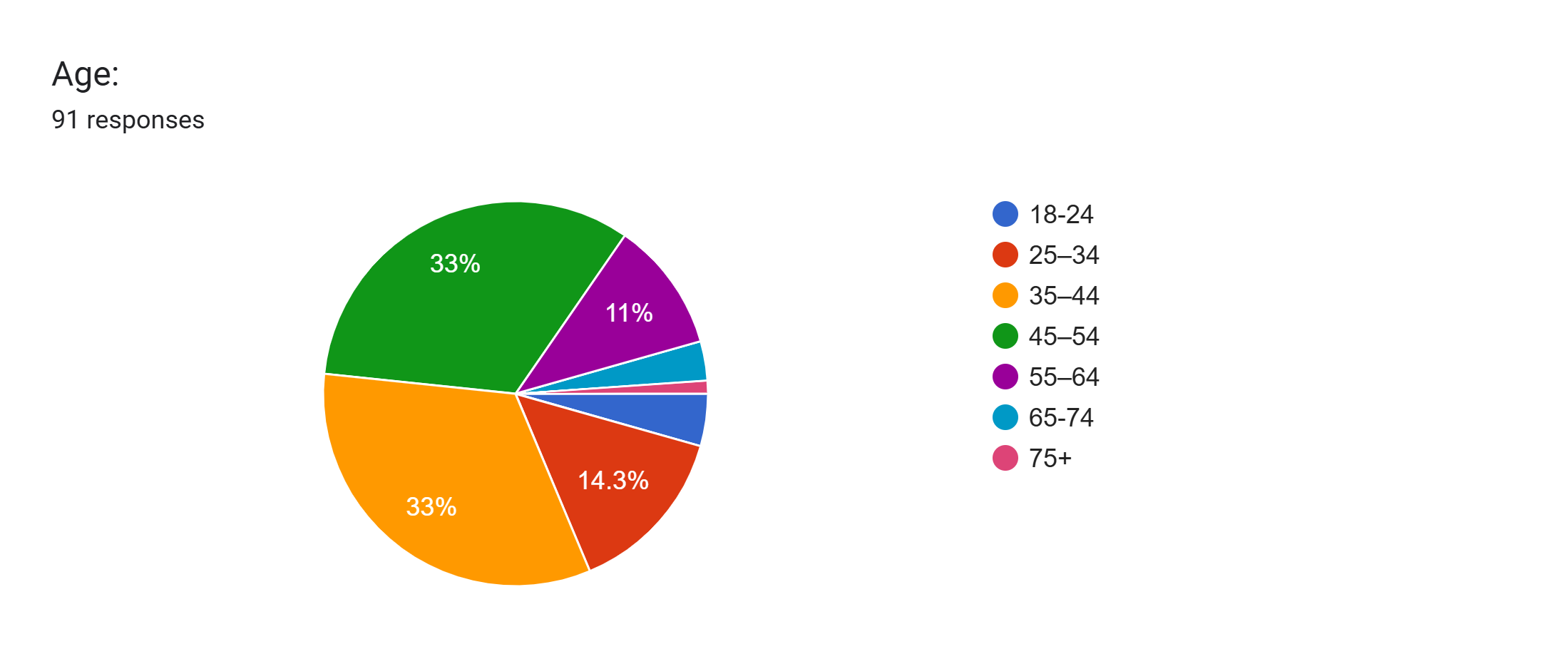
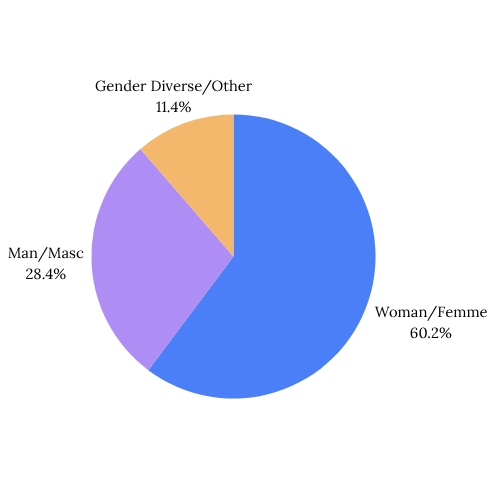
As one would hypothesise based on audio erotics stats, the early findings from my own auralism survey also skewed toward women and femme-identifying respondents from anglo saxon countries.
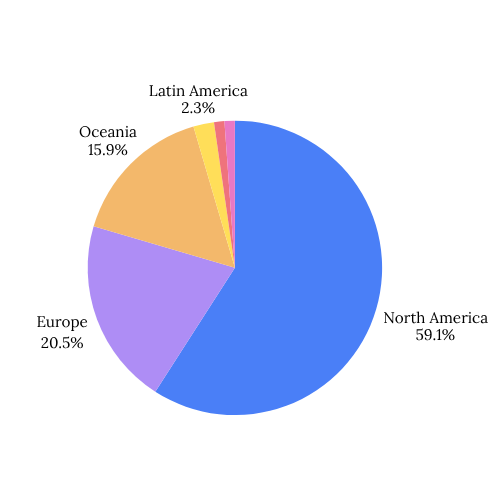
The largest single country was the United States with 50 respondents (56.8%), followed by Australia with 13 (14.8%) and the United Kingdom with 7 (8.0%).
Neurodivergence
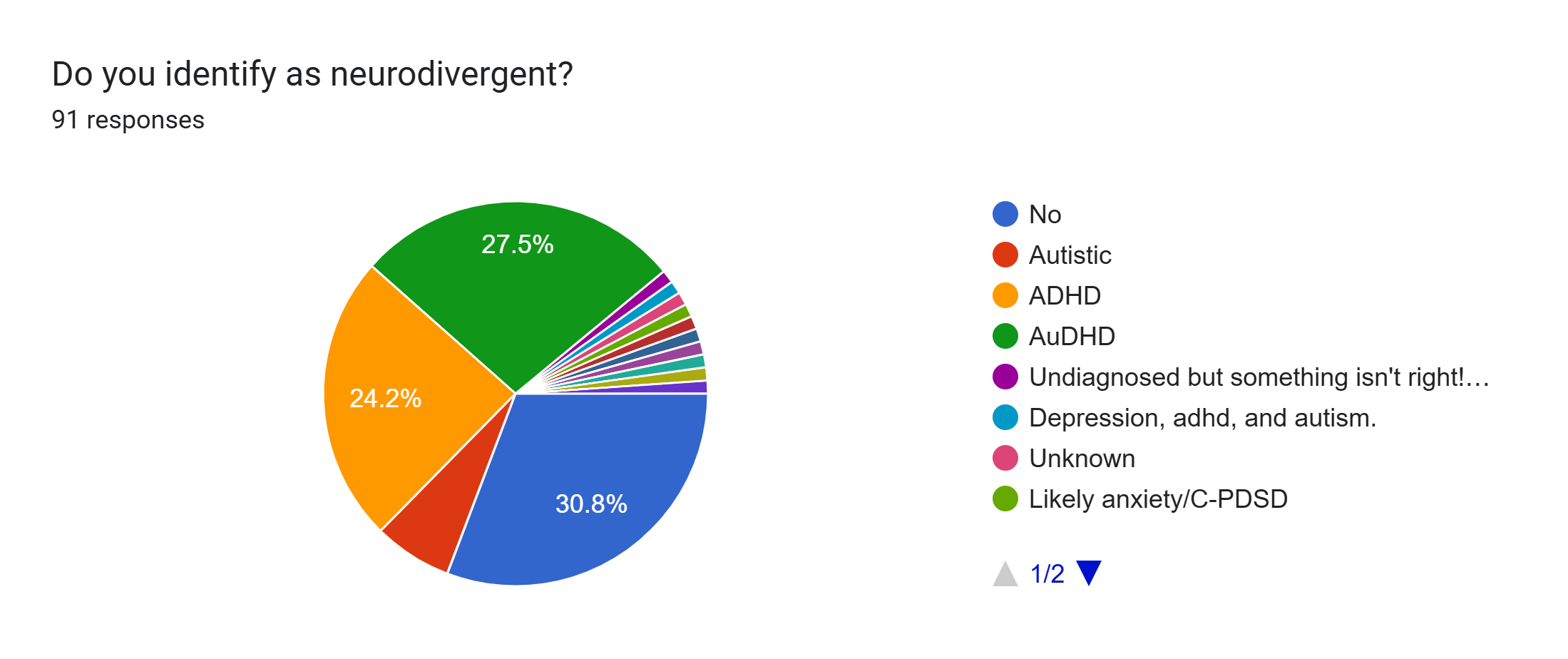
Large proportion identified as:
ADHD
autistic
AuDHD
Auralism may correlate with heightened sensory/emotional processing.
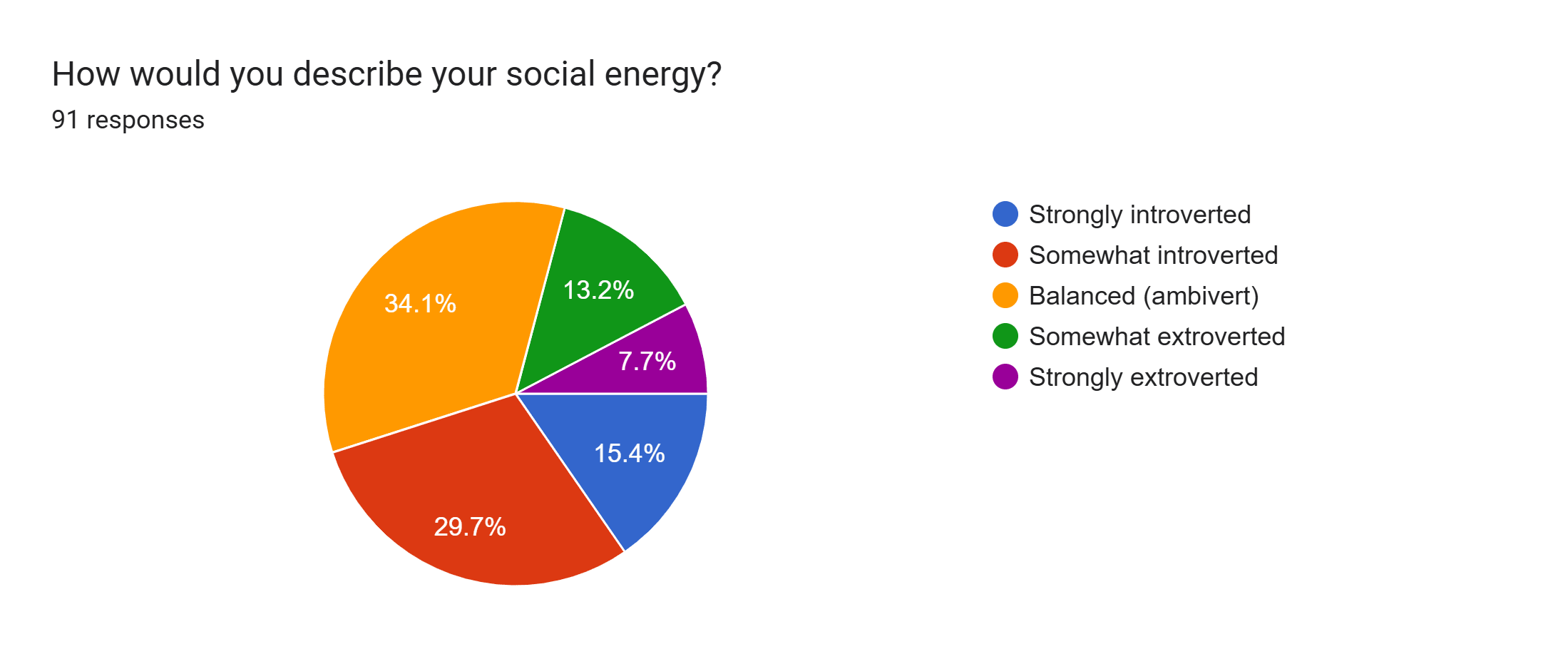
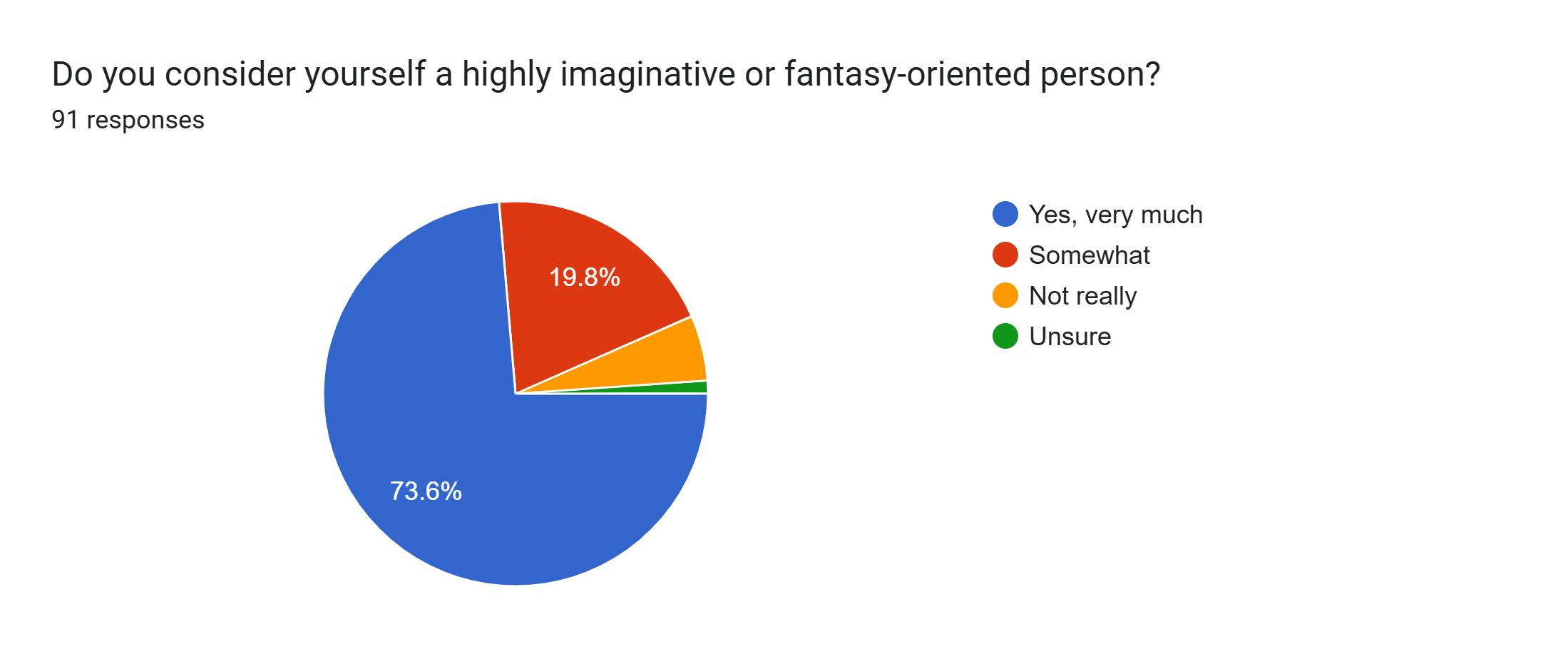
Introversion & Imagination
Most respondents:
introverted or ambiverted
highly imaginative
fantasy-oriented
Suggesting Auralism may involve immersive internal erotic processing.
Sound Sensitivity & Sound Oriented
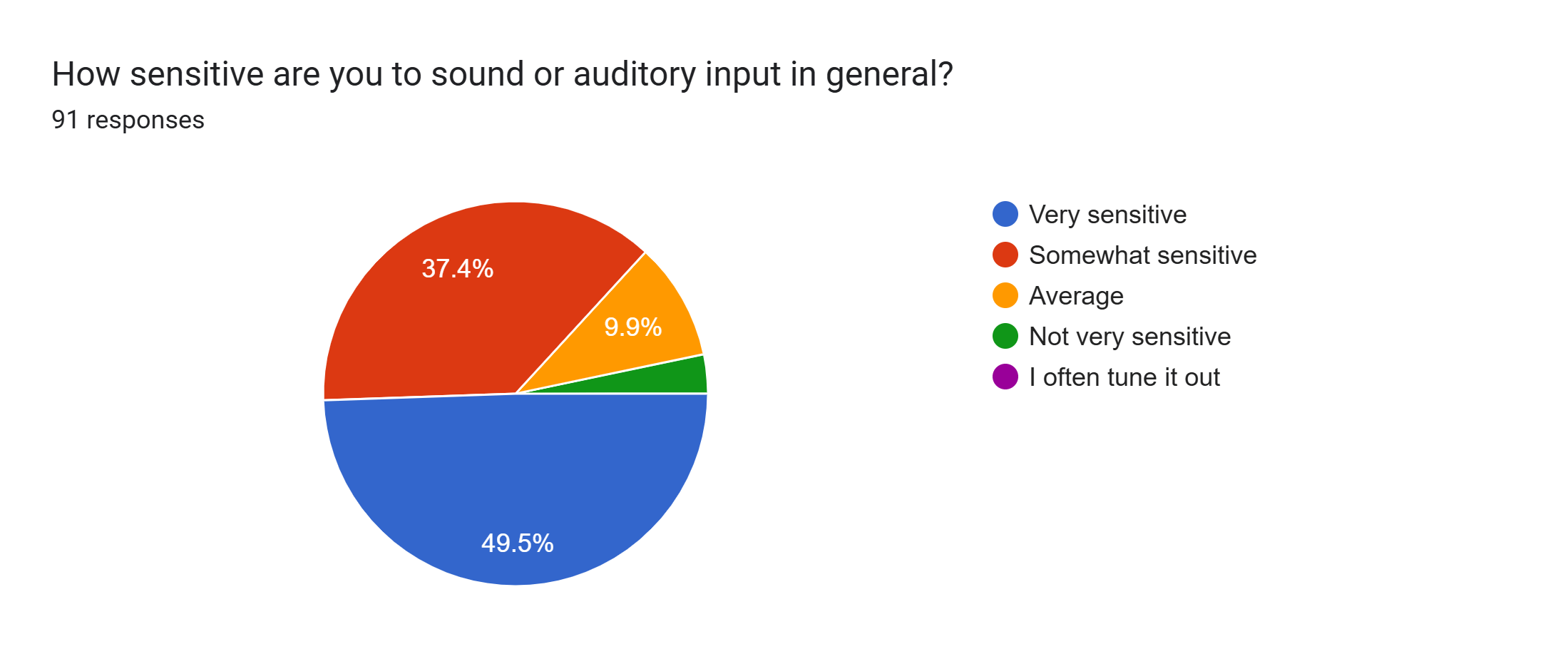
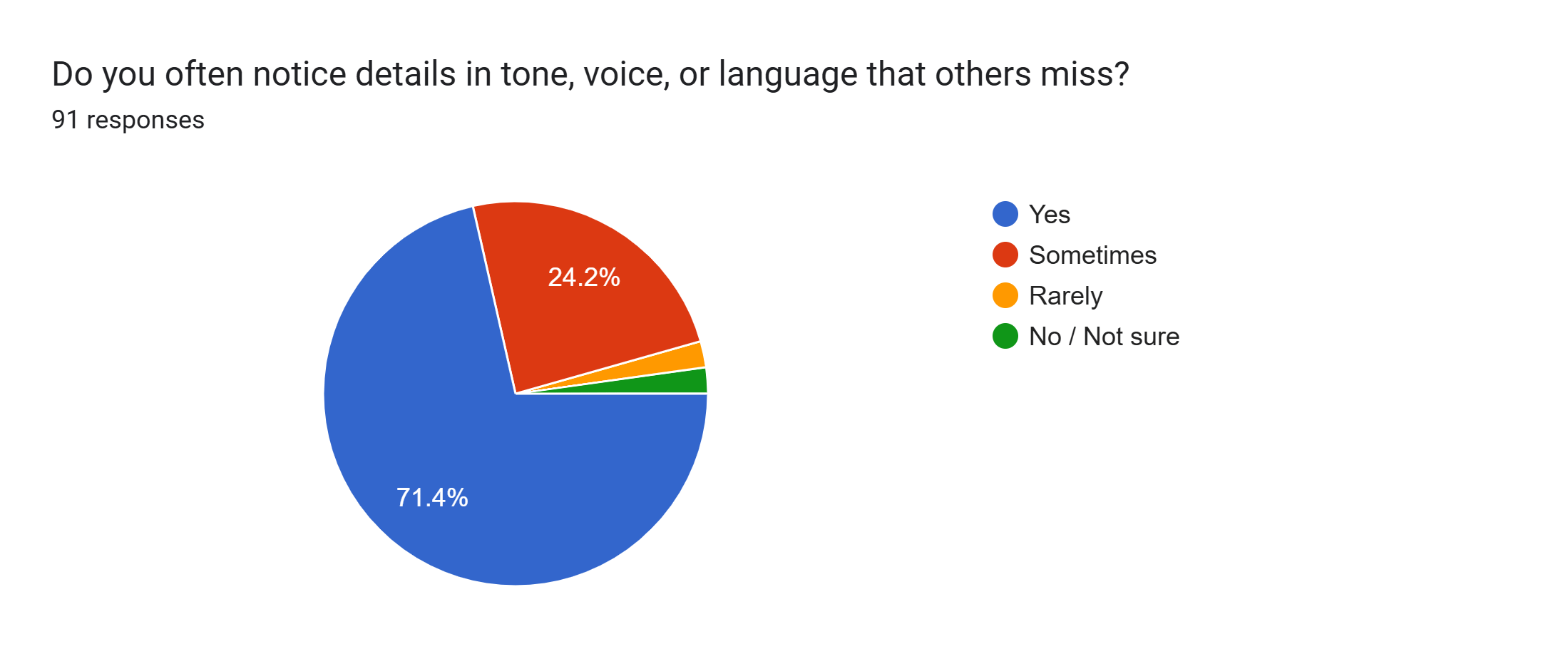
As expected most respondents:
very sensitive or somewhat sensitive to sound and auditory input
noticed details in sounds that others often miss
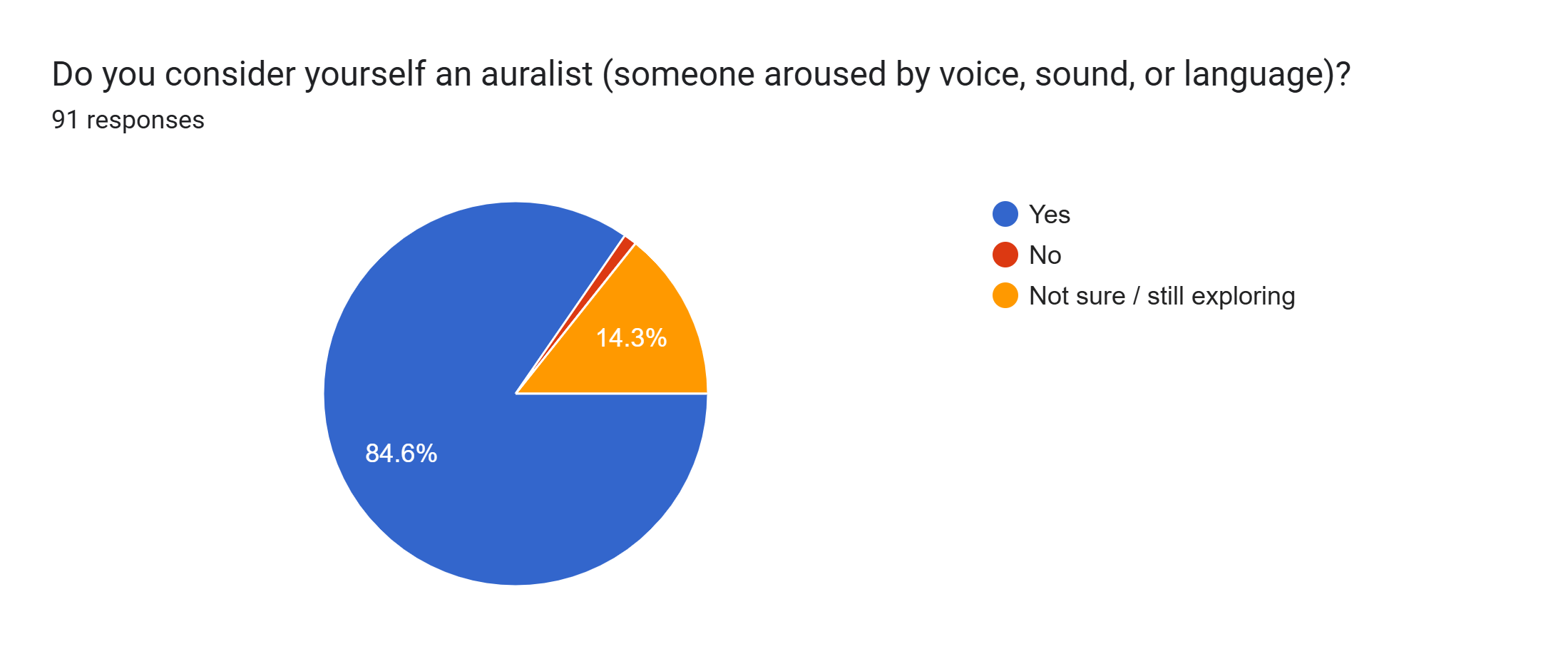
most self identified as an auralist
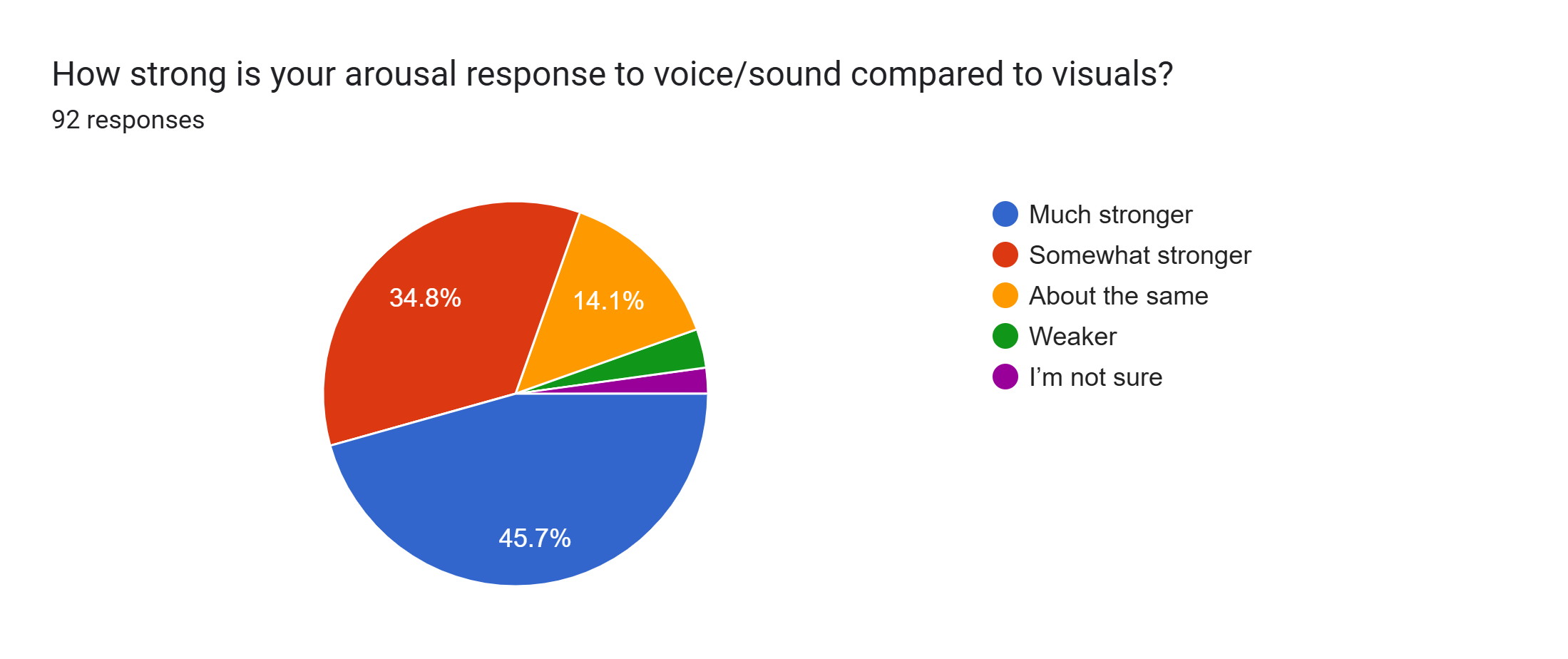
many (approx 80%!) had a stronger response to sounds over visuals
Preferred Sounds
Respondents:
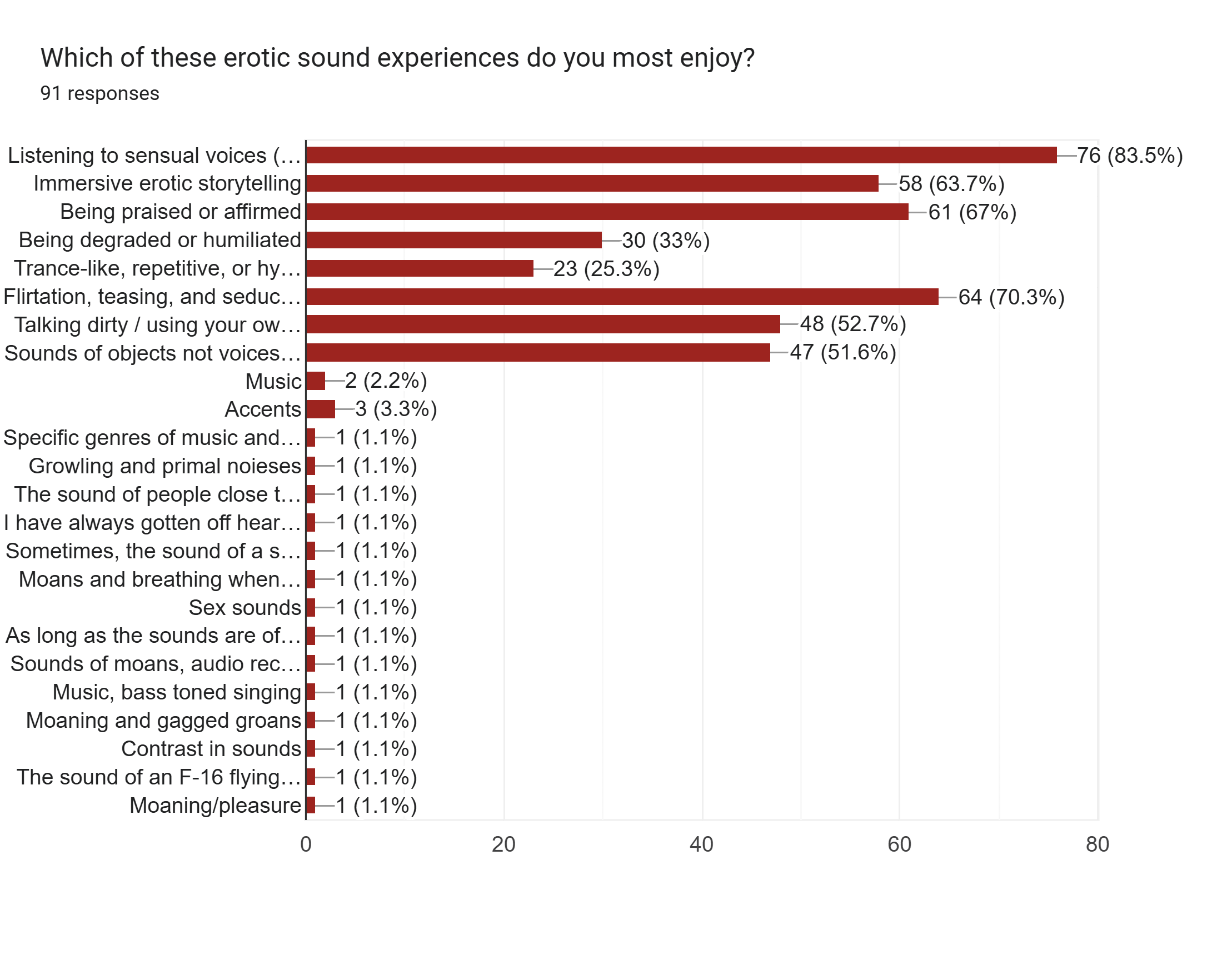
Preffered voice sounds such as sensuality, praise, storytelling and flirtation
Talking dirty was 5th most enjoyed voice sound
Over 50% enjoy sounds of objects not voices.
Interestingly only 1% most enjoyed sex sounds.
Emotional Effects of Sounds
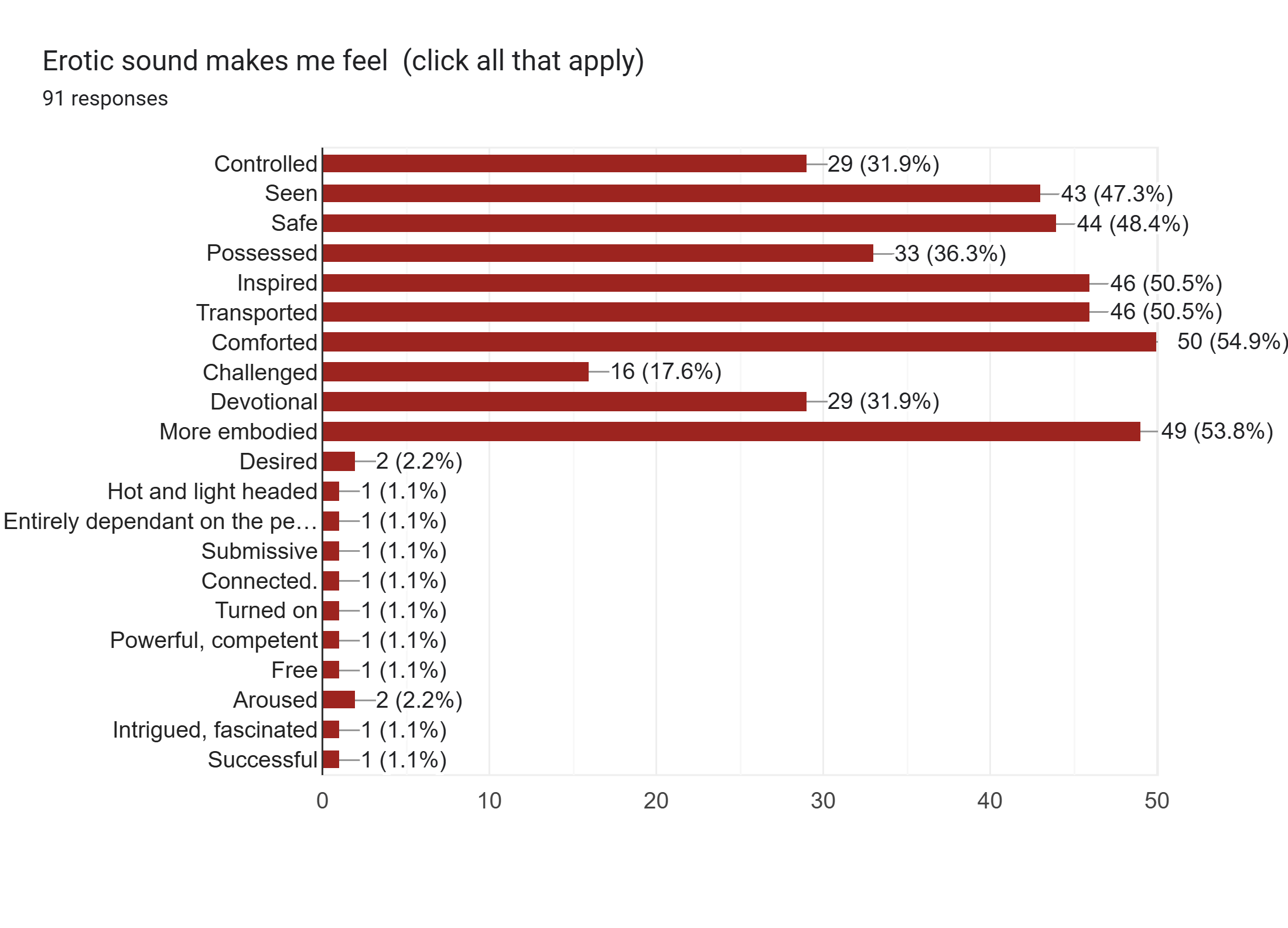
Most common emotional responses:
comfort
transported
inspired
safety
controlled
feeling seen
embodied
Erotic sound may function not just as arousal—but as emotional regulation, attachment activation, and embodied resonance. Only 2 responded that they feel aroused by sound and only 1 turned on.
When asked to descibe specifically how sounds affect their emotions and thoughts respondents were incredibly varied in their responses, for example:
“It can really pull me into a single frame of focus on the person making the sounds.”
“My partner’s voice makes me feel safe and turned on.”
“Immersive fantasy painted by carefully selected words and voice quality.”
“My thoughts shut off and I can feel my emotions more strongly.”
“Movement and sound guide the momentum of eroticism building within me.”
“It’s all sorts of consuming”.
Although varied, one thing shines through in all of these descriptions- the intensity of the response the individual has to their preferred sound(s) and the focus on emotions and embodiment.
Where Does Sound Land in the Body?
Different people experience erotic sound in radically different body locations.
Common responses:
pelvis/genitals
chest/heart
stomach/gut
head/mind
spine
throat
whole-body tingling
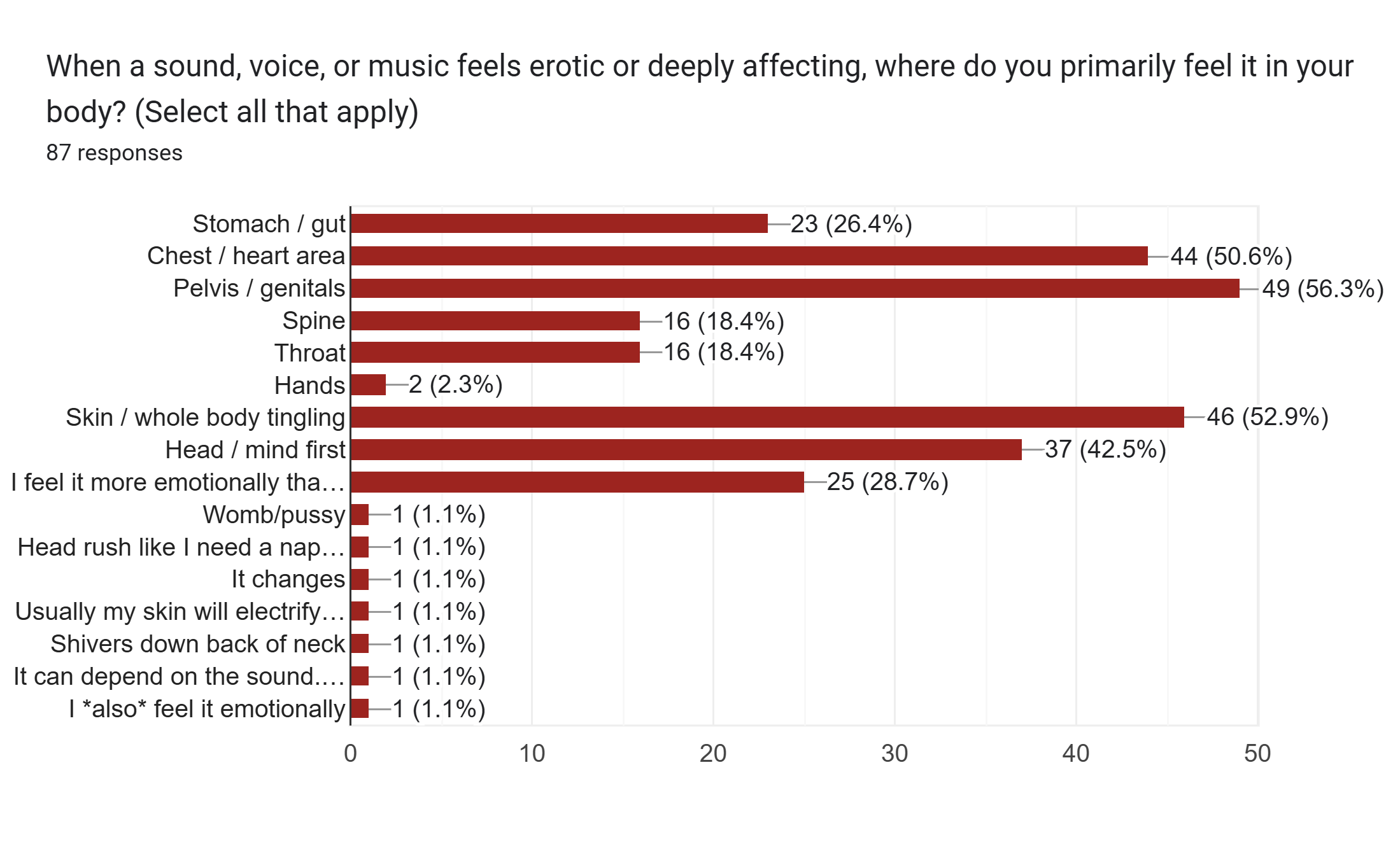
Could it be that auralism may involve “somatic resonance mapping” — the body processing sound as emotion, power, attachment, erotic charge etc?
Perhaps the human nervous system is wired to experience voice as a form of emotional touch?
Something to ponder as the research continues…
What about the Big O?
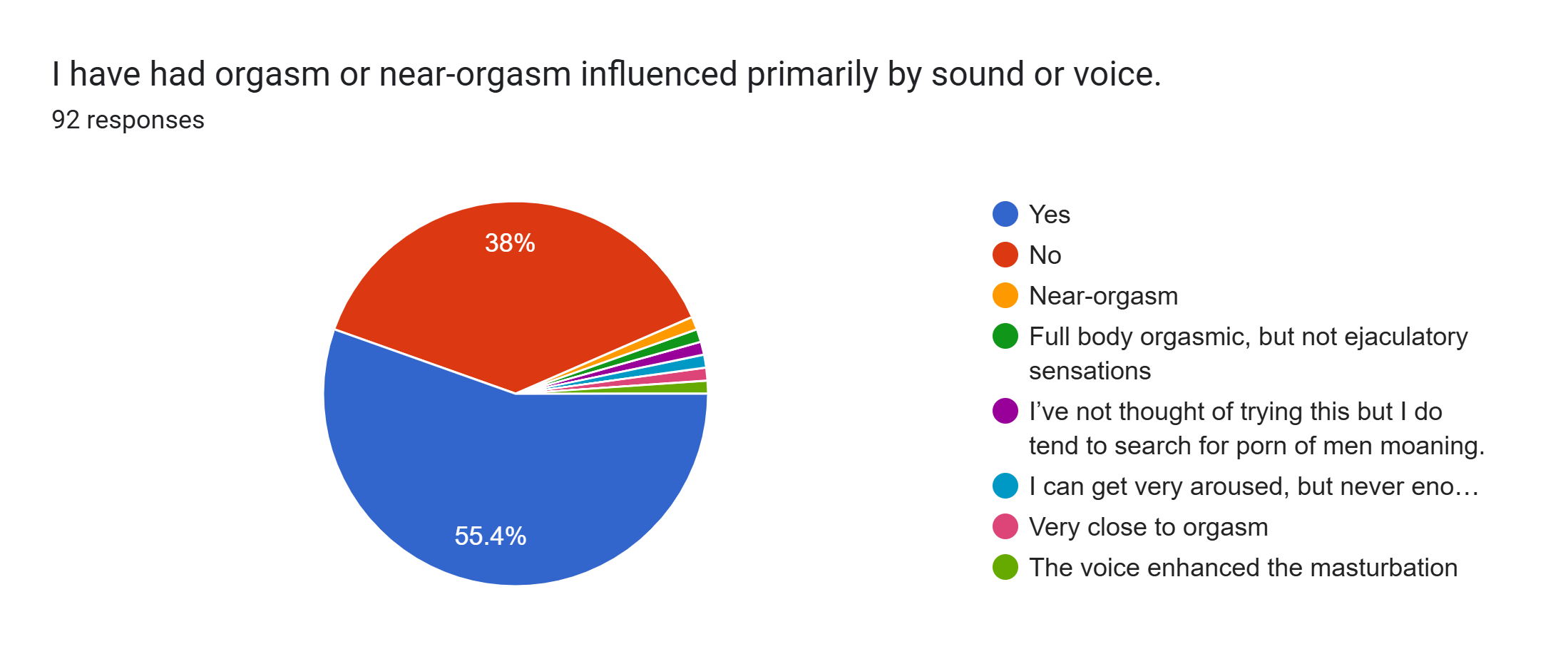
We know from previous research that some people can think their way to orgasm without physical touch, but what about by sound alone?
the majority (55.4%) said they have either had an orgasm or near-orgasm influenced by sound or voice.
“He talked to me, and I felt buzzy and aroused and towards the climax of the story he was telling, my body clenched tightly and I came. It was the same physical sensation as a regular orgasm for me.”
“Listening to Tschaikowsky 5th symphony i came really hard without touching myself.”
This made me curious about how often Music was a central theme for the auralists in the survey…
What about Music?
Somewhat surprisingly to me, music wasn’t as high as I thought it would be. I’m not sure of the number I was exactly expecting, but based on the ASMR research and the focus of auralism research on music itself previously, I would have hypothesised higher. At the very least I wasn’t expecting almost 20% of respondents to say “rarely” and almost half to say “sometimes”. What about you?
I think if anything this demonstrates the focus on the voice and how erotic and central communication through voice is for auralists.
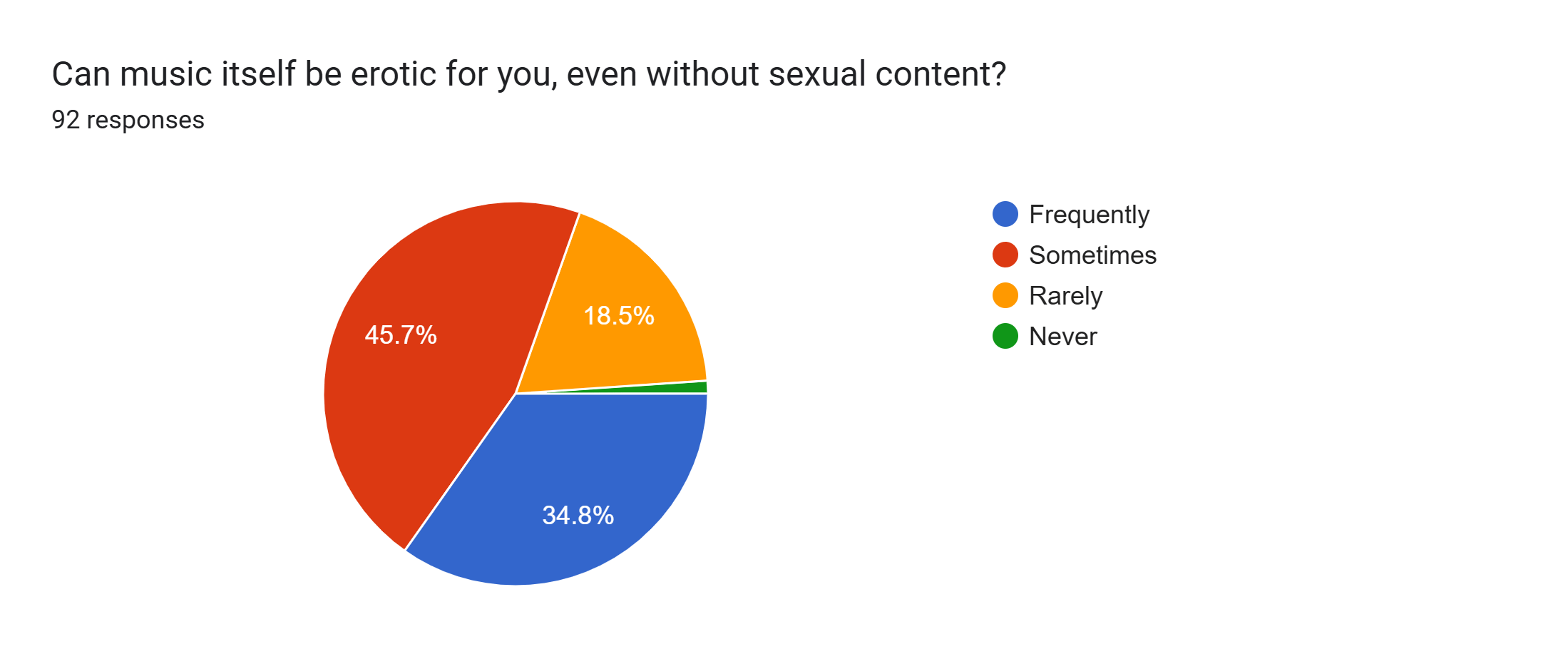
It appears that music is an important aspect of auralism to only some auralists….which brings me to one of the most exciting preliminary findings of the survey so far.
Emerging Auralist Archetypes
I asked respondents to explain in their own words the perfect aural experience, and some fascinating themes are beginning to emerge- including what appears to be auralist archetypes.
Yes it appears that there are multiple ‘types’ of auralists, and different auralists seek different sounds…I’d like to collect some more data before releasing these archetypes — 200 respondents or more, so please feel free to take the survey here or send the link to a friend you know that love sounds/post it in a forum where you feel it would be appreciated. The survey is currently at 92 respondents as of this writing, and I can’t wait to release more information about the emerging archetypes!
The Bigger Theory: Desire as Resonance
Could it be that auralism is not only about sound?
It may be also be about:
resonance
immersion
attention
attachment
nervous system entrainment
emotional synchronisation
symbolic activation
More on these in subsequent posts where we dive deeper into the data together.
For now, what is clear is that:
For some people, sound is not background to desire.
It is the erotic event.
Perhaps sexuality research has focused too heavily on what we see.
Because this data suggests clearly, that for some people atleast— desire enters through the ear first.
Auralism: a newly recognised erotic orientation?
In this self-selected auralism sample, sound does not function merely as erotic decoration. For many respondents, it appears to function as a primary pathway into arousal, embodiment, emotional regulation, relational surrender, and sometimes orgasm.
For a surprising share of respondents, sound was not foreplay to desire…it was the route to arousal, embodiment, and sometimes orgasm itself.
People often talk about sexuality as if desire begins with what we see or what we touch.
But this survey suggests that for some people, desire begins somewhere else entirely: in a voice, a tone, a cadence, a rhythm, a sound that enters the body before it is ever fully understood by the mind.
What emerged from these responses was not just arousal, but a psychophysiology of erotic listening.
Respondents described feeling comforted, safe, transported, seen, possessed, embodied.
They mapped sound onto their pelvis, their chest, their skin, their spine, their throat, their whole bodies.
And more than half reported orgasm influenced primarily by sound or voice.
The published research has not yet caught up to this phenomenon directly.
There is no established body of peer-reviewed work on orgasm from sound alone as such (atleast as far as I’m aware of— send it my way if you find it!).
But there is already strong adjacent evidence that auditory cues shape sexual arousal, that audio-only erotica can be physiologically engaging, that ASMR and musical frisson are real embodied states, and that orgasm itself need not be confined to genital touch.
In that gap between lived experience and formal science, auralism begins to look less like a curiosity and more like a neglected category of desire.
To be clear, I’m not suggesting that everyone is secretly an auralist.
But it appears safe to say from this data that some people seem to process erotic experience through sound in a primary way.
For them, sound is not background. It is not embellishment. It is not an accessory to the erotic. It is one of the erotic event’s central languages.
As a proud auralist myself it’s exciting to explore this topic in depth, and I’m excited to see(hear?) where the findings from the survey take us next.
Stay tuned for the second release where we explore the findings in more depth — including the auralist archetypes.
For now, some questions to ponder:
Has reading about auralism made you think differently about the erotic potential of sound? If so, how?
How can you explore the use of sound in your eroticism in a way that you haven’t before?
Where do you feel sounds that you find sexy in your body?
Think you might also be an auralist? Contribute to this research here.
I’d love to hear from you in the comments if this article resonated with you or opened your mind to new ways of exploring.
Thanks for reading!
Emma
Founder of Psychology of Desire | Host of The Erotic Realm podcast
Want to explore the psychology of your desire?
Emma offers 1:1 coaching via application - Details here.
Or grab yourself your very own Desire Diary here.
The Psychology of Desire partners with aligned brands in the realms of psychology, sexuality, and symbolic transformation. Interested in sponsoring? Start here.
p.s Want to explore my writing?
The Psychology of Desire Case File Series:
The Sole of Desire: Foot Fetish Origins | Psychology of Desire: Case File #1
The Female Orgasm Demystified | Psychology of Desire: Case File #3
My Erotic Journey: From Repressed to Expressed
The Shadow’s Playground: When Suppressed Desires Visit Us in Dreams
The Sole of Desire: Foot Fetish Origins | Psychology of Desire: Case File #1
What Your Erotic Dreams Reveal About Your Deepest Desires
The Secret Life of Your Desire
Why Your Desires Are More Normal Than You Think.
What If Everything You Know About Men and Women Is Wrong?
The Hidden Key to Lasting Desire: It’s Not What You Think
Are Men and Women Wired Differently For Desire?
And don’t forget my Jung of Sex Series:
Disclaimer: Some concepts discussed in this article remain under-researched and are presented as emerging exploratory frameworks.
References
Blood, Anne J., & Zatorre, Robert J.. (2001). Intensely pleasurable responses to music correlate with activity in brain regions implicated in reward and emotion. Proceedings of the National Academy of Sciences, 98(20), 11818–11823. https://doi.org/10.1073/pnas.191355898
Barratt, Emma L., & Davis, Nick J.. (2015). Autonomous sensory meridian response (ASMR): A flow-like mental state. PeerJ, 3, e851. https://doi.org/10.7717/peerj.851
Fisher, Danielle, et al. (2021). Audio described versus audiovisual pornography: Cortisol, heart rate and engagement in visually impaired versus sighted participants. Frontiers in Psychology, 12, Article 661452. https://doi.org/10.3389/fpsyg.2021.661452
Fredborg, Beverley, Clark, Jennifer, & Smith, Stephen D.. (2017). An examination of personality traits associated with autonomous sensory meridian response (ASMR). Frontiers in Psychology, 8, Article 247. https://doi.org/10.3389/fpsyg.2017.00247
Gao, Yue, et al. (2023). Distinct emotional and cardiac responses to audio erotica between genders. Behavioral Sciences, 13(3), 273. https://doi.org/10.3390/bs13030273
Komisaruk, Barry, & Whipple, Beverly. (2011). Non-genital orgasms. Sexologies, 20(3–4), e89–e90. https://doi.org/10.1016/j.sexol.2011.08.004
Krahé, Barbara, et al. (2017). Misattribution of musical arousal increases sexual attraction towards opposite-sex faces in females. PLOS ONE, 12(9), e0183531. https://doi.org/10.1371/journal.pone.0183531
Loui, Psyche, Wawrzynski, Joanna, & Nathanson, Rachel. (2014). Thrills, chills, frissons, and skin orgasms: Toward an integrative model of transcendent psychophysiological experiences in music. Frontiers in Psychology, 5, Article 790. https://doi.org/10.3389/fpsyg.2014.00790
McErlean, Amanda B., & Banissy, Michael J.. (2022). Beyond tingles: An exploratory qualitative study of the autonomous sensory meridian response (ASMR). PLOS ONE, 17(11), e0277962. https://doi.org/10.1371/journal.pone.0277962
Pfaus, James G., & Safron, Adam. (2024). Auditory cues alter the magnitude and valence of subjective sexual arousal and desire induced by an erotic video. Archives of Sexual Behavior, 53, 1045–1058. https://doi.org/10.1007/s10508-023-02802-4
Poerio, Giulia Lara, Blakey, Emma, Hostler, Thomas J., & Veltri, Tom. (2018). More than a feeling: Autonomous sensory meridian response (ASMR) is characterized by reliable changes in affect and physiology. PLOS ONE, 13(6), e0196645. https://doi.org/10.1371/journal.pone.0196645
Taylor, Jodie. (2018). Sound desires: Auralism, the sexual fetishization of music. In F. J. Gadon & E. Peraino (Eds.), The Oxford handbook of music and queerness (pp. xx–xx). Oxford University Press
This is epic!
According to the statistics presented, it would seem that we Latin Americans are erotically deaf!!! Lol!!!😭😭😭! Beyond that, the topic is fascinating and a hot-button issue. Excellent!