


If you want to deep dive into the mind of a foot fetishist I recommend listening to this episode of my podcast The Erotic Realm.
Welcome to the very first Psychology of Desire: Case Files—a series where I dissect the hidden logic behind our most curious turn ons and erotic fixations.
In this series we dare to go beyond the surface of eroticism and ask questions such as:
Why feet?
Why pain?
Why power, ritual, age gaps, control, fabric, voices, rituals, hands, filth, purity, gender, transgression…?
As a Jungian Sexologist and psychophysiological researcher, I’ve spent years exploring how our desires are shaped.
I’ve discovered that our desires are shaped by so many things—not just by brain wiring or hormones—but by symbols, stories, culture, memory, and the unconscious…just to name a few.
I created the Psychology of Desire because I am endlessly fascinated by how unique and complex each person’s eroticism is.
Sure there may be patterns in eroticism but how these patterns show up in each person is never the same.
Take the guests I have interviewed on The Erotic Realm for example- at the end of the conversation I ask them a complex question with a simple answer: if you were to sum up your sexuality in just one word in this moment what word would that be?
And guess what?
So far each guest has used a different word.
These Case Files are my attempt to break down the complex nature of eroticism into easy to explore stories.
I’m not here to pathologise desire.
I’m here to decode it.
To treat each desire as a map—not a mistake.
And perhaps to show that even your strangest turn on makes perfect psychological sense.
These case files aren’t just curiosities.
They’re keys to understanding and humanising desire.
So let’s open the first file together and dive in.

What is it about feet?
Love them or hate them- feet seem to be one of the most divisive topics not only in the fetish world- but when it comes to eroticism in general.
Foot fetish is simultaneously the most popular fetish, and arguably the most stigmatised fetish (how many times have you seen a foot fetishist be portrayed as a creep in a comedy film or tv show?).
Regardless of how you feel about feet, you have to admit- the divisive nature of feet itself is pretty interesting from a psychological point of view.
In this first Case File, we’ll explore foot fetishism through seven distinct but interconnected lenses.
Each one reveals a piece of the puzzle:
Historical & Etymological: Where the word fetish comes from, and why its magical origins matter.
Sexological History: How early thinkers like Binet and Krafft-Ebing shaped our modern understanding (and misunderstanding) of fetishism.
Prevalence & Gender: Just how common is it—and how much more common is it in men?
Neurological: What’s happening in the brain? Including a surprise hypothetical add on to the famous Ramachandaran theory.
Psychological & Symbolic: From early imprinting to feet as emotional truth-tellers.
Cultural & Devotional: How India, Italy, and other cultures eroticise feet through ritual, beauty, and reverence.
Together, these angles tell a story—not of perversion, but of pattern.
Not of disorder, but of depth.
This isn’t about reducing desire to brain chemistry or childhood memory or cultural ritual alone.
It’s about asking:
What does your desire mean?
What does your desire reveal?
And could your most “shameful” turn-on actually be one of the most human things about you?
Let’s begin.
All good stories start with a first step.
I began this essay at the most logical place- the beginning, thinking it would be easy:
The definition of, and history of the word fetish.
According to the American Psychological Association a person with a fetish has a sexual fixation on a non-living object or non-genital body part.
Seems simple enough right?
Well being the nerd I am I like to dive deep into the origins of words to fully understand their meaning.
I think it’s incredibly important to get a proper picture of what it is we are defining.
A Fetish History
It turns out the history of the word fetish is almost as interesting as the word itself.
Lets check out the etymology first.

early 17th century (originally denoting an object used by the peoples of West Africa as an amulet or charm): from French fétiche, from Portuguese feitiço ‘charm, sorcery’ (originally an adjective meaning ‘made by art’), from Latin facticius (Source: Oxford Languages).
Factitious refers to artificially created or developed (not to be confused with fictitious which means not real or true).
Fetish has French/Portuguese origins from the word feitico which means “spell” and Latin origins- from the term facticius i.e. “artificial”, given to an object that has power over others.
The etymology of Fetish therefore appears to have two main influences when spliced together: an artificially created charm or sorcery.
Note: while researching this I found 3 articles going into much detail about the history of the word throughout Africa and the words ties to colonialism. If interested these are in the further reading section below.
A fetish ties an inanimate object to magic in some way- it is an object which appears to hold special powers over the person.
Before we go on- a quick note on fetish vs kink: these two terms are often confused or used interchangeably. But there is an important distinction here that needs to be highlighted.
A kink refers to any sexual activity, practice or preference that deviates from what’s considered “normal” or “vanilla”
A fetish, on the other hand, specifically involves a sexual attraction to or fixation on a particular object, body part, or activity, which is typically not considered sexual in nature.
And as we have just explored- a fetish often has an almost magical influence over a person, which is why the word was adopted by early sexologists to describe the phenomena- which we will explore next.
Sexological History
While the anthropological use goes back to the 17th century and was shaped by colonial and religious interpretation of African spiritual practices, the sexual sense of "fetish" does not begin until the 19th century with Binet coining the term erotic fetishism (1887) and Krafft-Ebing popularising the term(1896).
Alfred Binet (Yes he wasn’t just interested in developing the IQ test. Turns out he was also very much into studying sexual behaviour) wrote a paper titled Le Fétichisme dans l'Amour ("Fetishism in Love"), where he analysed how certain objects or attributes become essential for erotic arousal. This is one of the earliest psychological discussions of sexual fetishism.
Binet suggested that fetishism was not a perversion, but a psychological mechanism through which certain objects or physical traits become erotically charged—essential, even necessary, for sexual arousal. He suggested that fetishistic desire often forms due to an impression made during childhood or early adolescence, at a time when the sexual instinct is beginning to awaken. The object becomes associated—through accident or intense emotional charge—with early erotic feeling.
Binet justified his use of the term “fetish” by drawing directly on its anthropological meaning:
"The fetishist attributes a mysterious power to an object, just as the religious believer does to a relic."
Richard von Krafft-Ebing had a much less sex positive view of fetishes and used the term "fetichism" (his spelling) to describe a pathological fixation on objects or body parts in Psychopathia Sexualis, a foundational text in sexology.
He framed it as a form of sexual perversion—consistent with 19th century medicalised views of sexuality.
One could argue that this is where the stigma surrounding fetishes such as the foot fetish (as well as many other aspects of what is now considered normal deviance in sexuality) likely began.
It’s still common for foot fetishists to be portrayed as a creep in mainstream media.
So one must ask- is there any truth behind the stigma of foot fetish being for only a few ‘creeps’ in our society?
Foot Fetish Facts
The common nature of the fetish suggests otherwise.
How many people have a foot fetish?
It may surprise you to learn that research of the general Population found that close to half of those surveyed (44.5%) were found to show interest in fetishism, with no difference in prevalence found between men and women.
So what about feet in particular?
How weird and unusual are you if you’re into feet?
The answer may surprise you.
In 2007, researchers analysed 381 Internet discussion groups focused on fetishes.
What they found was fascinating: nearly half of all body-part-related fetish interests — about 47% — were focused on feet and toes.
In other words, foot fetishism isn’t rare or weird and it’s actually the most commonly discussed body-part fetish online.
A Gendered Fetish
Foot fetishism is widely regarded as one of the most sexually dimorphic (gender-divided) fetishes, meaning it shows one of the largest gaps in prevalence between men and women among all paraphilic or fetishistic interests.
In a survey of over 4,000 Americans 18% of heterosexual men had foot-related fantasies, where as only 5% of heterosexual women showed interest in feet.
That’s a 3.6x difference, which is more extreme than most other fetish categories.
A Belgian study found similar results with 17% of men reporting a foot fetish vs only 4% of women: demonstrating a 4x difference in prevalence.
Analysis of pornographic search data also consistently shows that Foot fetish is a top category for male users, but barely registers for female users in fetish categories.
Note: if you happen to be one of the rarer female foot fetishists or you know of one let’s chat- I would love to interview one on my podcast The Erotic Realm!
So far we have discussed the history of the foot fetish, the etymology of the word itself and the prevalence of foot fetish.
We have covered the what, when, where and who…
The next logical questions to ask are….how and..why?
How does a foot fetish develop?
And why is it the most gendered fetish?
Let’s jump in.
Neurological basis for Foot Fetish
In his work on phantom limbs and neuroplasticity, Ramachandran discovered that after limb amputation, the corresponding area in the somatosensory cortex (an area of the brain that represents the physical body- see diagram below) is sometimes "taken over" by neighbouring body regions.
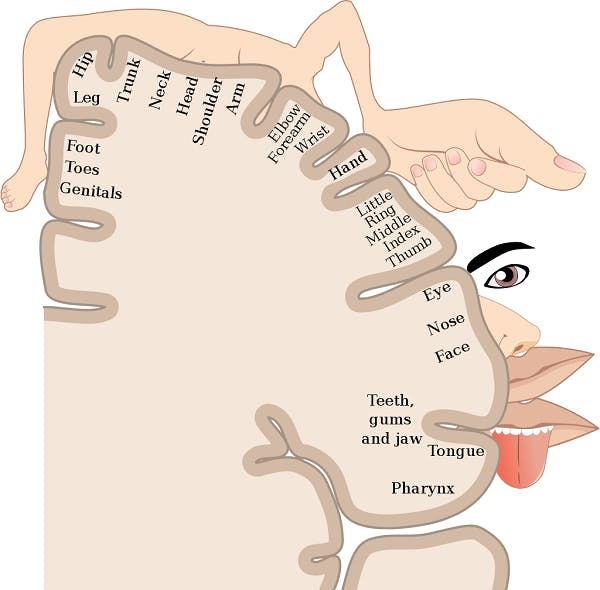
For example: If someone loses a hand, the face area (which is adjacent to the hand in the cortical map) might expand into the hand’s cortical territory.
As a result, touching the face can produce phantom sensations in the missing hand.
How This Relates to Fetishism:
Ramachandran extended this principle to foot fetishism by pointing out that:
In the cortical homunculus, the feet and the genitals are adjacent in the somatosensory cortex.
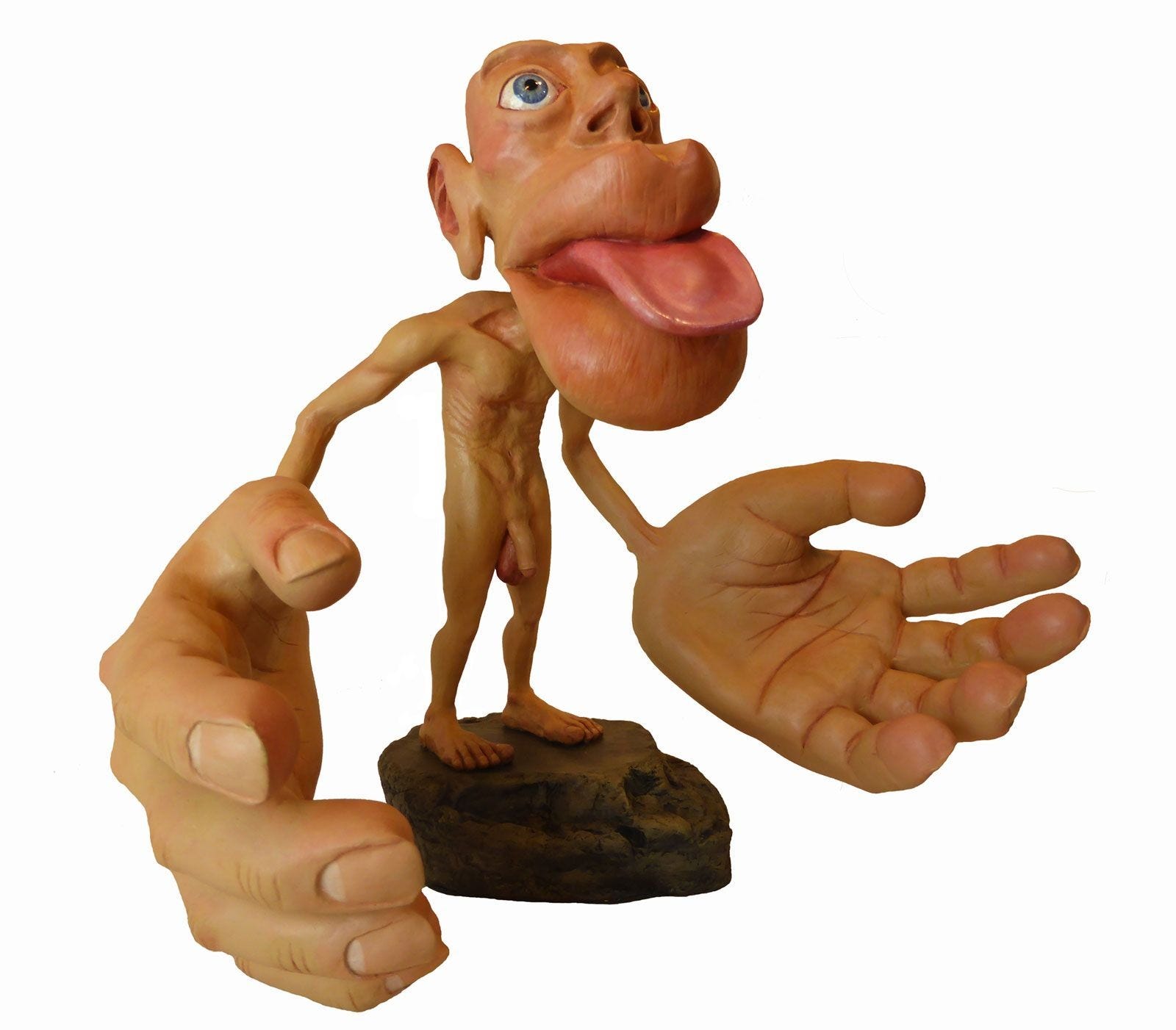
He speculated that in some individuals, there may be neural cross-activation or "crosstalk" between these two areas. This overlap or "miswiring" could potentially lead to sexual arousal from foot stimulation—i.e., foot fetishism.
In his book Phantoms in the Brain, Ramachandran elaborates on this idea, noting that the foot and genital areas are adjacent in the somatosensory cortex, and that this proximity might account for the prevalence of foot fetishes. He wrote:
"Maybe even many of us so-called normal people have a bit of cross-wiring, which would explain why we like to have our toes sucked."
A particular conversation with an engineer who had lost their leg below the knee confirmed Ramachandaran’s theoretical suspicions:
Well, I feel a little embarrassed to tell you this . . . Doctor, every time I have sexual intercourse, I experience sensations in my phantom foot . . . I actually experience my orgasm in my foot. And therefore it's much bigger than it used to be because it's no longer confined to just my genitals.
So it seems that foot fetishists may literally be “born that way” and have more of this cross neuronal wiring than the average non foot fetishist.
Humanises foot fetishists immediately, don’t you agree?
How cool is it when neuroscience can help explain such a perplexing fetish?!
What’s Sex Got to Do with it?
Although this is a compelling and fascinating approach to foot fetishes and rooted in hard science as well as rich case study history- one thing is missing from Ramachandaran’s approach.
Why are men 3-4x more likely to have a foot fetish than women?
I was pondering this question while writing the article when an idea struck me.
Maybe there are gender differences in the somatosensory cortex itself.
A quick google scholar search found a few results suggesting that the answer is: yes there are gender differences.
Neuroimaging studies show that men typically have a much larger and more distinct genital representation in the brain than women (e.g., Kell et al., 2005; Komisaruk et al., 2011).
It appears that I may have uncovered something that—astonishingly—no one seems to have formally proposed before.
What if that increased cortical real estate makes the male brain more prone to this kind of neural wiring—where foot and genital regions cross-activate?
In other words, the structure of the male sensory cortex may create a greater likelihood of foot fetish formation via adjacency.
To my knowledge, this synthesis has never been published before.
I’m calling it the Cortical Amplification Model of Foot Fetishism: a neurodevelopmental model that combines Ramachandran’s adjacency theory with sex-based differences in genital somatosensory mapping to explain why foot fetishism is so disproportionately common in men.
Note: This was a fun discovery along the way while writing this article and I’d love to hear from anyone who knows any research that proves or disproves this theory, I’m so curious to know more about this!
Psychological & Symbolic:
Could it be that we aren’t born that way but learned that way? Perhaps a foot fetish is a process of neuroplasticity that occurs over time (seems to be true in the case of my guest on The Erotic Realm who I interviewed- he has an intense foot fetish which he says grew over time and originated in him being made to massage his mothers feet after work regularly- episode link here).
This idea is backed up by science involving both rats and human studies.
The Jacket Fetish Experiment
In a 2013 study researchers explored whether male rats could develop a sexual preference—or "fetish"—for a specific object through conditioning.
They divided sexually naïve male rats into two groups:
Jacket Group: These rats wore a small, custom-made jacket during their first nine sexual encounters with receptive females.
Control Group: These rats mated without any jacket.
On the tenth trial, all rats were tested either with or without the jacket, regardless of their previous condition. The results were striking:
Control Group: 100% successfully mated, regardless of jacket presence.
Jacket Group: 100% mated successfully only when wearing the jacket. Without it, performance dropped significantly—only 60% achieved ejaculation.
This indicates that the jacket became a conditioned stimulus essential for sexual performance in the Jacket Group rats.
In other words they gave the rats a fetish for jackets.

So rats can be conditioned to have fetishes, what about humans?
Rachman’s Boot Experiment
In 1966 three male participants were exposed to a conditioning procedure where a neutral stimulus—a coloured slide of a pair of black, knee length women's boots—was consistently presented immediately before slides of nude women, which served as the unconditioned stimulus (US) eliciting sexual arousal.
Over multiple trials, the participants began to exhibit sexual arousal responses, measured via penile plethysmography (a ring around the penis measuring engorgement), to the boot images alone, indicating that the boots had become a conditioned stimulus (CS).
All three participants developed conditioned sexual responses to the boot images after varying numbers of trials (30, 65, and 24 trials, respectively).
Stimulus generalisation was observed, as participants also showed arousal responses to images of similar footwear, such as high-heeled shoes and sandals.
In other words, the researchers arguably gave the men a fetish for boots and a definite sexual interest in shoes in general.
Although this is fascinating, learned and conditioned behaviour doesn’t adequately account for the plethora of foot fetishists who say it was only one particular incident or experience that occurred in their younger years that resulted in their life long fetish.
A singular powerful experience
Fun fact about me: I trained in the History and Arts of the Dominatrix to understand the psychological nature of sexuality and my teacher Anne O Nomis who wrote an incredible book (it’s in the reference list- check it out!) taught me an interesting theory about how she believed a fetish formed from a singular experience.
Anne had witnessed a pattern in these fetishists who were defined by a singular powerful experience at a young age (commonly around the age of 8 or there abouts). The pattern often includes a potent mixture of a power dynamic, arousal and taboo.
For example I once had a client who was a child in the 60’s in the U.K when corporal punishment at school was still prevalent.
One lunch time he was “caught” peeking up a fellow female classmate's skirt and saw a glimpse of her white silk panties.
The teacher immediately reprimanded him in front of the whole class.
This mixture of power exchange - being reprimanded by an authority figure, arousal- seeing a girl’s panties for the first time, and taboo- being publicly shamed in front of his peers for his actions led to him forming a life long fetish for white silky panties.
He preferred them over any other sexual behaviour- even sex itself. Once this client had the understanding of the potent mixture that had let to his fetish formation he found peace with it and was able to enjoy it as opposed to shame himself for his abnormal interest.
Feet as emotional truth tellers.
There’s also something about the foot that resists masking.
Unlike the face or hands, which are trained to perform, the feet tend to express what’s real.
In somatic psychology and gesture theory, the feet are often where you’ll spot the truth first—subtle withdrawals, unconscious pointing, anxious fidgeting.
There’s whole articles discussing how to translate the foot due to the idea that it’s a truth teller (for e.g. https://www.scienceofpeople.com/feet-body-language/).
In Shibari (Japanese rope bondage) it’s taught that you can read the rope bottom’s (person being tied) emotions through their toes before you see it in their eyes.
The foot becomes a truth-teller- a kind of emotional barometer.
For those drawn to feet, it may not just be about the form of the foot, but could it potentially be about the rawness of unfiltered expression feet offer?
Could there be foot fetishists whose arousal comes through witnessing what cannot lie?
Symbolic Feet
Feet may also be eroticised through the various symbols that may personify.
1. Humility and Subservience
There’s something deeply symbolic about being at someone’s feet.
Whether it’s kneeling, bowing, or washing them these gestures aren’t just physical.
They signal a psychological descent.
A submission.
A reverence.
In BDSM, foot worship plays out this symbolism with erotic charge.
To kiss, kneel before, or serve someone’s feet is to place oneself below them—not just physically, but symbolically.
For some foot fetishists it is this emotional posturing of obedience, reverence, and surrender that turns them on.
2. Filth and Taboo
In many traditions feet are thought of as unclean, even offensive.
In some cultures showing someone the sole of your foot is a grave insult.
In others, feet are the lowest, dirtiest part of the body—both literally and symbolically.
From a Freudian perspective, this “dirtiness” is part of the appeal.
He argued that what’s forbidden often becomes eroticised when desire is displaced—feet become safe containers for illicit urges.
Filthy enough to feel transgressive, but not explicitly sexual in the conventional sense.
The thrill here is in the boundary crossing.
To lick, sniff, or be trampled by feet isn’t just about sensation but violating a cultural no no.
Being naughty.
For some foot fetishists, it may be about the blend of disgust and desire that gives the fetish its power.
3. Eroticism Through Concealment
The erotic mind loves suggestion.
And feet play perfectly into that.
Think about it: we’re not usually shown the feet in everyday seduction.
They’re hidden, dressed, accentuated and not explicitly exposed.
This makes them ripe for erotic projection.
The power lies not just in what’s revealed, but in what had been hidden.
In that slow reveal, the foot becomes a portal to something deeper.
A symbol of access.
Of invitation.
As we have seen, discussion of feet as symbols is tied to both cultural and devotional aspects.
Based on the symbolic nature we have just explored- if you had to guess, which two countries would you think are most commonly tied to foot fetishes?
Cultural & Devotional:
1. India
In Indian culture, feet are deeply revered.
Touching the feet of elders or gurus is a traditional gesture of devotion and feet of deities are often worshipped.
Dominatrices in India have reported a significant demand for foot worship sessions.
A 2020 article in The Print describes how women with well-groomed feet engage online audiences, with some clients paying substantial fees for private foot-focused interactions.
The dominatrices report that the rituals often blur the line between traditional reverence and erotic adoration, highlighting how culture can influence the formation of fetishes.
2. Italy
This was a surprising one for me, but when you think about it, it makes sense.
Italy’s foot fetishism appears to rise from a different, though equally symbolic, source.
The country’s Catholic heritage includes ritual acts such as foot washing and kissing, similar to that found in India.
However it seems modern Italian culture remains fascinated by feet: recent data from Grindr (2024) even showed Italy had the highest percentage of users identifying with foot fetishes!
One could argue that this is influenced by the Italians' artistry when it comes to foot wear suggesting a culturally supported eroticisation of the foot resulting in fetish.
Conclusion
In conclusion: the foot fetish is much more complex than one might think at first.
As with all of our desires, there is likely a plethora of influences that create our strongest desires.
To think that you understand all fetishes or desires because you understand one persons fetish or desire is to think wrongly.
We all have such unique erotic minds that are endlessly fascinating- and half the fun is going on the journey to discover our sexuality for ourselves.
Perhaps there are multiple types of foot fetish with different types of psychophysiological configurations. A spectrum of foot fetish one might say? Four people could have a different foot fetish profile.
For example:
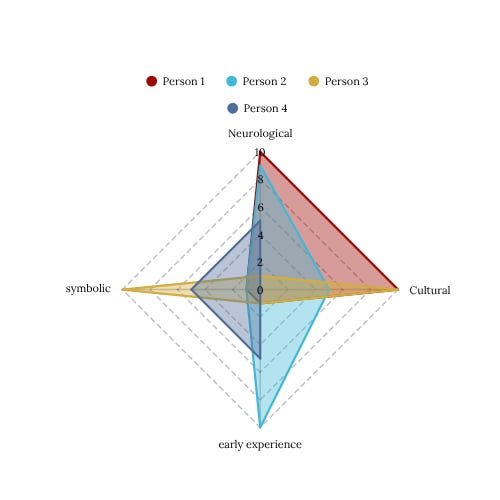
As you can see each of the 4 people in the diagram have a completely different foot fetish profile. I have a feeling these individual differences ring true across all sorts of fetishes and desires.
This is why I find the Psychology of Desire so fascinating!
The individual differences in Desire and Sexuality are endless.
Thanks for reading if you made it this far, you’re officially a sex nerd like me!
Some questions for you to ponder.
If you are a foot fetishist did you see your self reflected in one or more of the ideas? If so, which one(s) and why?
Did reading this case file change your mind about foot fetishists at all? If so how?
Has considering the complex nature of a singular fetish led you to ponder your own desires in a different way?
This was the very first in my new series Psychology of Desire: Case Files.
I’ll be releasing a case file every month as a deep dive into a specific desire.
I hope you enjoyed the ride and will come on the journey with me as I crack open more case files.
If you have a suggestion for the next case file, feel free to let me know in the comments!
Emma
The Voice of Desire Psychology
Founder of Psychology of Desire | Host of The Erotic Realm podcast
Want to dive deeper into your desires with me personally? I offer 1:1 Coaching via application. Find out more here.
If this Case File stirred something in you—if you felt seen, unsettled, or intrigued—it’s because your desire is already waking up to a new language.
I’m currently creating two courses that speak directly to this.
Activate Your Desire is a quick, potent introduction to my Desire Activation Model™. It helps you identify your unique ignition style and begin rewiring how you relate to arousal—perfect if you're at the edge of a breakthrough and need a guided nudge.
Decode My Desire is the deeper journey—the full map. It’s where I walk you through the erotic architecture of your mind, help you uncover your hidden turn-on patterns, and reshape desire from the inside out.
If either course calls to you, now’s the time—presale is open for a limited time.
The Psychology of Desire partners with aligned brands in the realms of psychology, sexuality, and symbolic transformation. Interested in sponsoring? Start here.
p.s Want to explore my writing?
What Your Erotic Dreams Reveal About Your Deepest Desires
My Erotic Journey: From Repressed to Expressed
The Secret Life of Your Desire
Why Your Desires Are More Normal Than You Think.
What If Everything You Know About Men and Women Is Wrong?
The Hidden Key to Lasting Desire: It’s Not What You Think
Are Men and Women Wired Differently For Desire?
And don’t forget my Jung of Sex Series:
p.p.s Want to check out my projects?
Listen to The Erotic Realm podcast here.
Support The Erotic Realm Confessional here.
Be part of The Deep Desire Project here.
References
Aggrawal, A. (2009). Forensic and medico-legal aspects of sexual crimes and unusual sexual practices. CRC Press.
American Psychological Association. (2020). Publication manual of the American Psychological Association (7th ed.). American Psychological Association.
Bering, J. (2010). The belief instinct: The psychology of souls, destiny, and the meaning of life. W. W. Norton & Company.
Binet, A. (1887). Le fétichisme dans l'amour. Revue Philosophique de la France et de l'Étranger, 23, 143–167.
Freud, S. (1953). Three essays on the theory of sexuality (J. Strachey, Trans.). In J. Strachey (Ed.), The standard edition of the complete psychological works of Sigmund Freud (Vol. 7, pp. 123–245). Hogarth Press. (Original work published 1905)
Grindr Inc. (2024, December 5). Not your average year-end report: Grindr unveils UNWRAPPED 2024. Business Wire. https://www.businesswire.com/news/home/20241205511204/en/
Holvoet, L., Huys, W., Coppens, V., Seeuws, J., Goethals, K., & Morrens, M. (2017). Fifty shades of Belgian gray: The prevalence of BDSM-related fantasies and activities in the general population. The Journal of Sexual Medicine, 14(9), 1152–1159. https://doi.org/10.1016/j.jsxm.2017.07.003
Jannini, E. A., Scorolli, C., Ghirlanda, S., Enquist, M., & Zattoni, S. (2007). Relative prevalence of different fetishes. International Journal of Impotence Research, 19(4), 432–437. https://doi.org/10.1038/sj.ijir.3901573
Kell, C. A., von Kriegstein, K., Rösler, A., Kleinschmidt, A., & Laufs, H. (2005). The sensory cortical representation of the human penis: Revisiting somatotopy in the male homunculus. Journal of Neuroscience, 25(25), 5984–5987. https://doi.org/10.1523/JNEUROSCI.1269-05.2005
Komisaruk, B. R., Beyer-Flores, C., & Whipple, B. (2006). The science of orgasm. Johns Hopkins University Press.
Lehmiller, J. J. (2018). Tell me what you want: The science of sexual desire and how it can help you improve your sex life. Da Capo Lifelong Books.
Nomis, A. O. (2013). The history & arts of the dominatrix. Von Zos.
Oxford Languages. (n.d.). Fetish. In Oxford English Dictionary. https://languages.oup.com/google-dictionary-en/
Pfaus, J. G., Kippin, T. E., Coria-Avila, G. A., Gelez, H., Afonso, V. M., Ismail, N., & Parada, M. (2012). Who, what, where, when (and maybe even why)? How the experience of sexual reward connects sexual desire, preference, and performance. Archives of Sexual Behavior, 41(1), 31–62. https://doi.org/10.1007/s10508-012-9935-5
Ramachandran, V. S. (1994). Phantom limbs, neglect syndromes, repressed memories, and Freudian psychology. International Review of Neurobiology, 37, 291–333. https://doi.org/10.1016/S0074-7742(08)60375-6
Ramachandran, V. S., & Blakeslee, S. (1998). Phantoms in the brain: Probing the mysteries of the human mind. William Morrow & Company.
Rachman, S. (1966). Sexual fetishism: An experimental analogue. Psychological Record, 16(3), 293–296.
Van Edwards, V. (n.d.). Feet body language: What your feet reveal about you. Science of People. https://www.scienceofpeople.com/feet-body-language/
Von Krafft-Ebing, R. (1896). Psychopathia sexualis (12th ed.). [English translation; publisher varies].
Further Reading on the Origins of the Term “Fetish”
Pietz, W. (1985). The problem of the fetish, I. Res: Anthropology and Aesthetics, 9, 5–17. https://jewishphilosophyplace.com/wp-content/uploads/2017/06/pietz-fetish-i.pdf
Pietz, W. (1987). The problem of the fetish, II: The origin of the fetish. Res: Anthropology and Aesthetics, 13, 23–45. https://english.hku.hk/staff/kjohnson/PDF/PietzWilliamRESfetishPART2spring1987b.pdf
Pettinger, D. (2005). Why fetish? Class, taste and the problem of the aesthetic in fetishism. Ephemera: Theory & Politics in Organization, 5(3), 350–365. https://d1wqtxts1xzle7.cloudfront.net/31037905/Pettinger_WhyFetish-libre.pdf
Oh. My. Goodness, Emma!! Can I just take a moment to appreciate the work and effort you’ve put into this? Love the in-depth information through all the lenses (and I don’t even care about feet 😂). Well done.
I’ll need to take some notes and gather my thoughts before I leave a thorough comment. I also need to listen to the previous podcast but, I’ve read this post and I am fascinated!
Congrats and well done, Emma!